The opposition is a professional, not a monster. Often it is more of a professional than the operative across the table: better trained, better resourced, and working on home ground. The difference between a clean mission and a funeral is almost never courage; it is whose Quartermaster had the better week, whose Handler remembered one more detail, whose Analyst saw the pattern first.
This chapter is a gallery of those professionals: the sentries who do not quite look up at the right moment, the colonels who do, and the three or four extraordinary minds across the century whose careers are built entirely on hunting people like you. Read it the way a case officer reads a dossier on a rival service: slowly, respectfully, and with a pencil in hand.
How This Chapter Works
Division 5 uses the standard Exodus NDS adversary framework, Minion, Elite, Nemesis, with two Universe-specific modifications. Every Elite and every Nemesis in this chapter carries their own Compromise Track (Chapter Eight), tracked in the reverse direction: it measures how badly the opposition has been burned, flagged, or exposed by the operative’s work. And every statblock carries an era tag; the format note below explains how to read it.
The chapter is organized by tier: Minions as group-pool statblocks for the crowd scenes intelligence work generates, Elites with full characteristic blocks and signature tricks, and Nemeses written as campaign-scale threats with dossier-style writeups and recurring vendetta hooks. A short gallery of opposing services then sketches the institutional antagonists at the level of reputation, doctrine, and signature behaviors, and a closing threat environment section handles the non-human opposition, from checkpoint infrastructure to algorithmic analysis.
A Note on Statblock Format
Every statblock in this chapter follows the Exodus NDS Core Rules format, with two additions:
- The era tag appears in the top-right of the block: SW (Shadow War), LD (Long Dark), NS (Nightscreen), or Any. Statblocks tagged Any have near-identical stats across all three eras and differ only in flavor; most others travel between eras with only cosmetic changes. Statblocks tagged with a specific era are calibrated to that era’s equipment catalog and doctrine; GMs running them in other eras should adjust weapon qualities and the Cyber skill presence accordingly.
- The Compromise relationship (Elites and Nemeses only) is a narrative note describing how the adversary tracks the player operatives, and it drives how the adversary reappears across the campaign. A Nemesis at Compromise 0 knows nothing about the team; at Compromise 3, the Nemesis has a file; at Compromise 5, the Nemesis has faces, names, and a list of places to look.
A Note on Scale
Division 5 is not a firefight-first game. Combat encounters should be decisive, purposeful, and tied to the operation’s stakes. The adversaries in this chapter are weighted accordingly: the Minion group-pool exists to make chase scenes, infiltrations, and gunfights feel dangerous without drowning the table in individual statblocks, and Elites and Nemeses are designed to be threats in scenes the players have already decided to engage: interrogations, meetings, honey traps, final confrontations, rescues, and direct-action beats.
If a session produces a statline-heavy combat round, keep the focus on operational stakes rather than attrition. Who is exposed? What evidence remains? Which asset is now in danger? Which route is no longer clean? These questions, more than any Wound total, are what the opposition in this chapter is built to press.
Using the Era Tags in Mixed-Era Campaigns
A multi-era campaign may feature the same character, or the same institution, across two or three eras. Several statblocks in this chapter are deliberately built to travel: The Cleaner works in every era, and the Architect has a Long Dark predecessor and a Shadow War grandfather built into the fiction. Use these cross-era anchors to give a long campaign a sense of generational continuity.
Adversary Stat Block Reference
The narrative entries below give doctrine, texture, and scenario use. The blocks in this reference are the authoritative table stats. If an older prose entry lists abbreviated stats, use the block here.
Default attacks and actions. Armed adversaries use the weapon profiles in Chapter Six. Unarmed attacks use Brawl, Damage equal to Might, Critical 5, Range Engaged. Social pressure actions use the listed social or intelligence skill and normally inflict Strain, Legend hits, asset Exposure, or Attribution signatures rather than Wounds. Surveillance and counterintelligence actions usually create Soft Signals, advance a Pursuit Clock, mark a Legend hit, or add dice to the hostile Attribution pool.
Minion Blocks
Wehrmacht Sentry (Minion) · SW
- Group Size: 2-6.
- Skills: Ranged 2, Perception 2, Resilience 2, Athletics 1.
- Abilities: Calls reinforcement after the third clear anomaly unless silenced, isolated, or deceived.
- Equipment: Karabiner 98k or MP40, field torch, whistle, military papers.
Gestapo Street Detail (Minion) · SW
- Group Size: 2-4.
- Skills: Perception 3, Surveillance 3, Streetwise 2, Ranged 2, Deception 2.
- Abilities: Second Pair - If the team spots one detail, another detail may already be positioned one block away. Add +1 Bane to checks that assume only one tail exists.
- Equipment: Walther PPK, identification papers, notebook, plain coat.
Abwehr Radio-Intercept Crewman (Minion) · SW
- Group Size: 2-3.
- Skills: Cryptography 2, Perception 2, Knowledge (Geopolitics) 2, Tradecraft 1, Ranged 1.
- Abilities: Direction Finding - An unencrypted wireless transmission in range creates a Soft Signal within one hour; encrypted traffic takes three times as long but still narrows the search.
- Equipment: Direction-finding receiver, logbook, headphones, sidearm.
Stasi Patrol Officer (Minion) · LD
- Group Size: 2-5.
- Skills: Perception 3, Surveillance 2, Interrogation 2, Ranged 2, Resilience 2.
- Abilities: Procedure First - The first contact is Hard to bluff; after a successful first exchange, checks ease by one step unless new suspicion appears.
- Equipment: Makarov PM, notebook, radio, uniform.
Warsaw Pact Border Guard (Minion) · LD
- Group Size: 2-8.
- Skills: Ranged 3, Perception 2, Resilience 2, Athletics 2.
- Abilities: Death Strip Doctrine - Inside a lethal border zone, they shoot first and file the report later. Outside it, procedure controls escalation.
- Equipment: AKM, fixed light machine gun if posted, radio, flares, dog team if assigned.
Bloc Surveillance Team (Minion) · LD
- Group Size: 4-6.
- Skills: Surveillance 3, Stealth 3, Streetwise 3, Drive 2, Perception 3.
- Abilities: Rotating Tail - The first successful check to spot them identifies only one member. Fully breaking contact requires winning the Pursuit Clock or three consecutive counter-surveillance successes.
- Equipment: Civilian clothes, cameras, two vehicles, radios.
Private Security Contractor (Minion) · NS
- Group Size: 2-8.
- Skills: Ranged 3, Brawl 2, Perception 2, Resilience 2, Athletics 2.
- Abilities: Rapid Response - Reinforcements arrive one round or one narrative beat earlier than expected on protected property.
- Equipment: Glock 19, soft armor, encrypted earpiece; HK MP7 for high-posture sites.
Airport Security Officer (Minion) · NS
- Group Size: 2-6.
- Skills: Perception 3, Surveillance 2, Interrogation 1, Cyber 1.
- Abilities: Secondary Screening - On a failed Legend or Forgery check, the scene moves to a controlled room and the Legend takes one hit before further rolls.
- Equipment: Uniform, scanners, database terminal, sidearm where jurisdiction permits.
Plainclothes Surveillance Team (Minion) · NS
- Group Size: 4-8.
- Skills: Surveillance 4, Stealth 3, Cyber 2, Drive 3, Perception 3.
- Abilities: Passive Infrastructure - Once per scene, add +1 Boon from CCTV, ALPR, cell metadata, or a micro-UAV unless the team has already scrubbed that channel.
- Equipment: Concealed sidearms, multiple vehicles, encrypted comms, micro-UAV, city-camera access.
Elite Blocks
SD Interrogator (Elite) · SW
- Skills: Interrogation 4, Perception 3, Knowledge (Geopolitics) 3, Deception 3, Medicine 2, Ranged 2.
- Abilities: The Name You Haven’t Given Yet - Once per scene, name one concealed fact. If correct and the subject is a PC, the subject spends 1 Fortune Point or marks one Legend hit. If the subject is an NPC, the GM assigns an equivalent cost: Strain, Asset Exposure, lost Trust, or a revealed detail.
- Equipment: Luger P08, concealed blade, subject file, immaculate uniform.
Abwehr Counterintelligence Officer (Elite) · SW
- Skills: Surveillance 3, Tradecraft 3, Knowledge (Geopolitics) 3, Perception 3, Ranged 2, Negotiation 3.
- Abilities: Professional Courtesy - Once per scene, offer a real deal. If accepted, clear one operative Compromise and burn the current Legend in the Abwehr file.
- Equipment: Walther PPK, tradecraft kit, concealed radio, permissive papers.
KGB Colonel (Elite) · LD
- Skills: Tradecraft 4, Negotiation 4, Interrogation 3, Perception 4, Knowledge (Geopolitics) 4, Ranged 2.
- Abilities: The Quiet File - Once per scene, reveal a non-public fact about an operative. Inflict 2 Strain and one Legend hit if the reveal names a Legend.
- Equipment: Makarov PM, diplomatic passport, leather notebook, tailored clothes.
Stasi Case Officer (Elite) · LD
- Skills: Surveillance 4, Interrogation 4, Deception 3, Perception 4, Knowledge (Geopolitics) 3, Streetwise 3.
- Abilities: The File Exists - Once per operation, introduce a prior witness statement, hotel record, or border note. The team must clear it or take one Attribution Soft Signal.
- Equipment: Makarov PM, case files, informant notes, official vehicle access.
Cyber-Intelligence Analyst (Elite) · NS
- Skills: Cyber 5, Knowledge (Geopolitics) 4, Perception 3, Surveillance 3, Cryptography 4, Deception 2.
- Abilities: Pattern Flag - Once per session, convert one Digital Soft Signal into a Contextual signature unless the team wins an opposed Cyber or Tradecraft check.
- Equipment: Secure workstation, access tokens, encrypted phone, analyst cell.
Corporate Security Lead (Elite) · NS
- Skills: Ranged 4, Leadership 3, Perception 3, Surveillance 3, Brawl 3, Drive 2.
- Abilities: Layered Response - The first alarm brings minions; the second locks exits; the third brings police or state-service liaison.
- Equipment: Glock or SIG sidearm, soft armor, building access, contractor response team.
The Cleaner (Elite) · Any
- Skills: Tradecraft 5, Deception 4, Stealth 4, Perception 4, Ranged 3, Melee 3, Forgery 3.
- Abilities: Already in the Room - Once per campaign arc, reveal that the Cleaner was present in a prior scene under a harmless identity. That scene becomes compromised and triggers Attribution.
- Equipment: Era-perfect civilian kit, concealed weapon, cleanup tools, access credentials.
Nemesis Blocks
Der Falke (Nemesis) · SW
- Skills: Tradecraft 5, Surveillance 5, Knowledge (Geopolitics) 4, Interrogation 4, Perception 4, Deception 4, Ranged 3.
- Abilities: The Controlled Set - If Der Falke captures a wireless operator or handler, he may run one false transmission before the team knows the asset is compromised.
- Equipment: Walther PPK, briefcase, Paris safe house, controlled-set files.
- Peril Uses: Spend Peril to reveal a watched dead drop, turn a captured Minion into a controlled courier, or pre-place an Abwehr team at a predicted rendezvous.
Shcherbakov (Nemesis) · LD
- Skills: Tradecraft 5, Knowledge (Geopolitics) 5, Interrogation 4, Negotiation 4, Surveillance 4, Perception 5, Deception 4.
- Abilities: The Mirror Operation - Once per operation arc, reveal that the KGB is pursuing the same target by a parallel route. The team must beat the mirror operation, not merely the original obstacle.
- Equipment: Diplomatic passport, paper archive, trusted department, personal Makarov.
- Peril Uses: Spend Peril to introduce an old file, redirect an allied service through KGB influence, or turn a prior D5 pattern into a predictive ambush.
The Architect (Nemesis) · NS
- Skills: Knowledge (Geopolitics) 5, Cyber 4, Negotiation 5, Deception 4, Perception 4, Tradecraft 3, Charm 4.
- Abilities: The Acquired Operation - Once per arc, Meridian purchases access to a data stream, contractor, or client-service liaison that reframes the operation as a private-sector problem.
- Equipment: Meridian platform, executive security, encrypted devices, legal and corporate shields.
- Peril Uses: Spend Peril to surface a digital trace, activate a private security team, freeze a cover account, or push hostile attribution through a commercial client.
Adversary Tactics and Use Notes
| Adversary | Primary Actions | Tactics | GM Use |
|---|---|---|---|
| Wehrmacht Sentry | Rifle fire, alarm call, checkpoint challenge | Holds position, calls help, fights as a group. | Gate, bridge, depot, patrol obstacle. |
| Gestapo Street Detail | Tail, stop-and-question, concealed pistol | Watches in layers; arrest is someone else’s job. | Street pressure and discovery scenes. |
| Abwehr Radio-Intercept Crewman | Direction finding, log analysis, sidearm defense | Avoids combat; turns radio traffic into search zones. | Wireless risk and countdown pressure. |
| Stasi Patrol Officer | Document check, questioning, sidearm | Escalates procedurally, files everything. | Long Dark public-space pressure. |
| Warsaw Pact Border Guard | AK fire, spotlight, alarm flare | Prevention by deterrence; an incident on their shift ends careers. | Border crossings and exfil failures. |
| Bloc Surveillance Team | Rotating tail, vehicle pursuit, photography | Maintains contact, avoids confrontation, writes reports. | Surveillance-detection runs. |
| Private Security Contractor | Pistol or SMG fire, tackle, lockdown call | Secures principal or site before pursuing. | Modern facility and convoy pressure. |
| Airport Security Officer | Document scan, interview, secondary screening | Separates travelers, delays until databases answer. | Legend and exfiltration tests. |
| Plainclothes Surveillance Team | Digital tail, drone overwatch, vehicle pursuit | Combines people with infrastructure. | Nightscreen ambient surveillance. |
| SD Interrogator | Interrogation, psychological pressure, pistol | Separates subjects, uses files, breaks Legends first. | Capture scenes and moral pressure. |
| Abwehr Counterintelligence Officer | Deal-making, surveillance, pistol | Offers exits that cost the operation. | Professional mirror scene. |
| KGB Colonel | Negotiation, file reveal, controlled arrest | Wins without drawing a weapon. | Long-term rivalry and social threat. |
| Stasi Case Officer | Informant pressure, files, interrogation | Turns records into leverage. | Network pressure and asset fear. |
| Cyber-Intelligence Analyst | Pattern flag, system lockout, trace | Stays off-site, escalates digitally. | Nightscreen trace and attribution. |
| Corporate Security Lead | Armed response, lockdown, liaison call | Layers contractors, police, and legal threat. | Corporate facility opposition. |
| The Cleaner | Disguise, cleanup, precise violence | Appears after the team already made mistakes. | Consequence made personal. |
| Der Falke | Controlled set, surveillance prediction, interrogation | Turns captured communications against D5. | Shadow War campaign hunter. |
| Shcherbakov | Mirror operation, archival prediction, diplomatic pressure | Lets the institution do the fighting. | Long Dark season antagonist. |
| The Architect | Data acquisition, contractor deployment, legal pressure | Buys access, converts traces into products. | Nightscreen corporate nemesis. |
Minions
Minions in Division 5 are the everyday opposition: the individuals whose job description contains some version of “watch the door and call someone if anything happens.” They are trained, paid, and usually armed; they simply are not the people the operation is about. Handled with discipline, they are background. Handled with panic, they are the reason an operation becomes a page in the file at Langley titled Lessons Learned.
All Minions use the Exodus NDS Minion group rules. A single Minion is trivial; three are a problem; six are a crisis. A Minion group shares one Wound pool, acts as a single entity on its initiative slot, and makes one check per round using the listed shared skill rating. Group Size tells the GM how many figures share the Wound pool; it does not add extra Ability dice by itself. If numbers, position, or coordination make the group more dangerous, use ordinary Boon/Bane dice , difficulty, cover, alarms, or reinforcements instead of a separate scaling rule.
Shadow War Minions
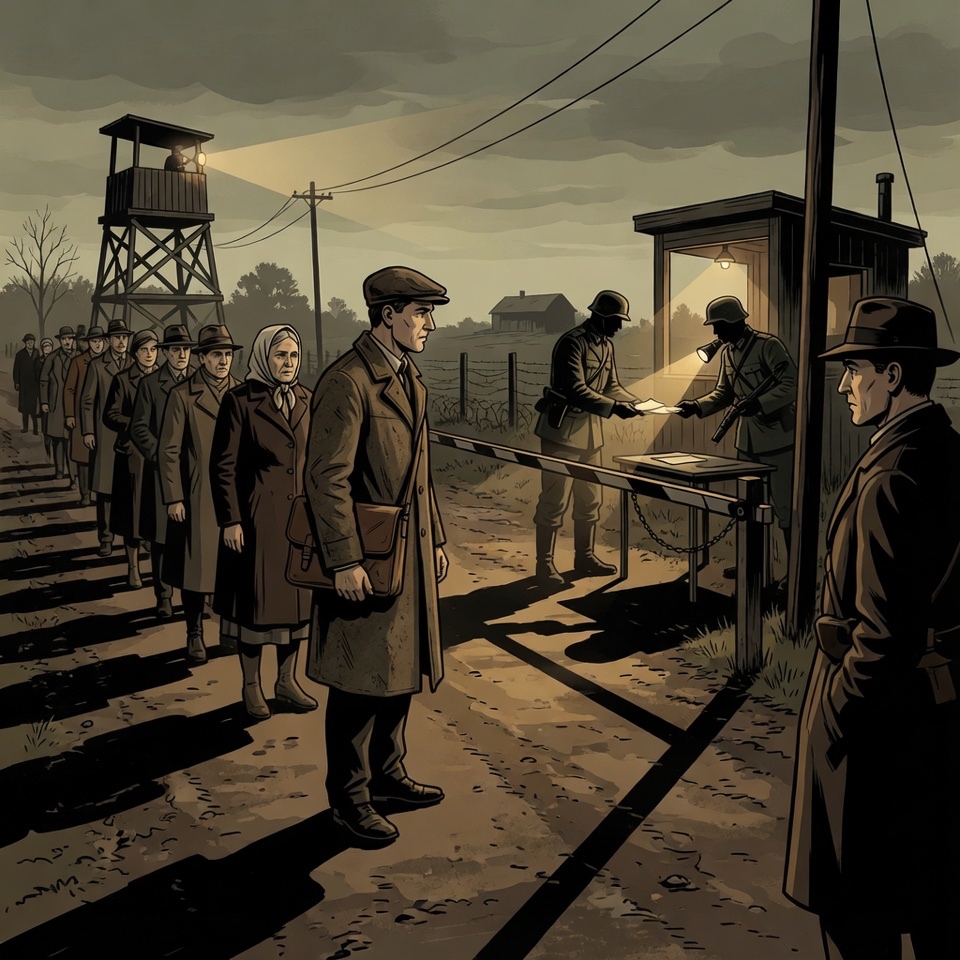
Wehrmacht Sentry · SW
The regular soldier on gate duty, radio duty, bridge duty, or patrol. Cold, bored, and armed.
Group Pool Notes: Effective in groups of three or more. Post them where the operation must pass rather than where a fight would be interesting: gates, bridges, depot fences. Their slowness to raise the alarm is the window good tradecraft exploits.
Gestapo Street Detail · SW
Plainclothes counterintelligence on the street: two men in dark overcoats, one of them always ten paces behind the other. This is the Gestapo that finds, not the Gestapo that interrogates.
Group Pool Notes: Deploy them when the street itself should feel hostile. Hostile Surveillance difficulty increases by one step while they are on scene.
Abwehr Radio-Intercept Crewman · SW
Technically competent, operationally narrow. Sits in a van or a basement with a valve receiver and a pair of headphones. The enemy of every D5 wireless operator.
Group Pool Notes: Use them as countdown pressure on any operation that keys a wireless set. Their receivers reach roughly five kilometers; encryption costs them precision, degrading the fix from a building to a neighborhood.
Long Dark Minions
Stasi Patrol Officer · LD
The omnipresent East German policeman. Polite. Memorizes faces. Reports everything.
Group Pool Notes: Stasi doctrine is to escalate only on confirmed anomaly. The danger is the notebook, not the sidearm: what a patrol officer files today is what a case officer reads next month.
Border Guard: Warsaw Pact · LD
The man at the wall, the fence, the checkpoint, the wire. Young, armed, and deeply aware that his commanding officer’s career depends on nothing happening on his shift.
Group Pool Notes: Where the team meets them decides the scene. The same crossing that is a document problem at a checkpoint is a shooting problem on the wire, and the wrong choice turns an exfil into an international incident.
Surveillance Team: Generic Bloc · LD
A four-to-six person tail team in civilian clothes, using the standard Moscow-rules tradecraft of the era. Rotating footmen, a car or two, and a control running the whole thing from a café or a third-floor window.
Group Pool Notes: The signature Long Dark Minion group. Pursuit-phase difficulty against a surveillance team starts at Hard and decreases by one step per successful Tradecraft check the operative passes. A team that fully loses contact abandons the operation and files a Subject has gone to ground report within the hour.
Nightscreen Minions
Private Security Contractor · NS
The modern lobby goon in a dark suit with an earpiece. Trained (often ex-military), armed (usually concealed), and paid by the hour.
Group Pool Notes: On protected property, speed is their entire doctrine: the lobby team is seconds away and the response team is right behind it. The plan has to be finished before they arrive, because they will arrive.
Airport Security · NS
The threat here is the boarding lane: document anomalies, body-language cues, and the quiet word with a supervisor that ends an exfiltration.
Group Pool Notes: Document checks against a compromised Legend succeed automatically for Thin Legends, check at Hard difficulty against Standard, and at Severe against Deep; a failure sends the scene to secondary screening.
Plainclothes Surveillance Team · NS
The updated version of the Long Dark team, with the addition of mobile phones, vehicle-mounted cameras, and, increasingly, drones and facial-recognition live feeds from the city’s camera network.
Group Pool Notes: What separates them from their Long Dark ancestors is that the city works for them. Footmen can lose a subject; the infrastructure never gets tired, never gets made, and never files a bad report.
Using Minions at the Table
Treat a Minion scene as a question the operation has to answer. Do we go around them? Do we bluff them? Do we take them? What does taking them cost?
The table should hit Minion scenes with one of four approaches, and the approach determines which mechanics matter:
Avoidance. The operative bypasses the Minion entirely: over the wall, around the patrol, through the service entrance. Resolved with Stealth, Coordination, or Tradecraft checks. Leaves no trace.
Deception. The operative passes the Minion using a Legend, a cover story, or a distraction. Resolved with Deception, Charm, or Forgery checks. May add hits to the Legend’s Burn Track if the check fails.
Subversion. The operative turns, bribes, or otherwise neutralizes the Minion without violence. Resolved with Negotiation, Streetwise, or Interrogation. Generates an Asset or a warm contact, or a loose end, depending on how the operative handled the aftermath.
Violence. The operative takes the Minion out: lethally or otherwise. Resolved with Brawl, Melee, Ranged, or Wetworker talent checks. Leaves a body, a missing person, or a blown alarm. Almost always adds Compromise marks.
GMs are strongly encouraged to telegraph the cost of each approach before the players commit: the body gets found, the missing sentry gets noticed, the alarm the colonel’s daughter heard over the phone call at 11:40 p.m. gets referenced in the after-action report. These consequences are what make the tradecraft mean anything.
A Note on Named Minions
Occasionally the table will find itself attached to a Minion, the waiter who was kind to the Face during a brutal operation, the teenage border guard the Handler turned in 1978 and has thought about ever since. When this happens, promote the Minion to a named NPC at the speed of the fiction. A named Minion gets a name, a face, and one piece of backstory the players know. They do not get Elite stats, they stay Minion-tier mechanically, but they stop being a group-pool figure and start being a person.
These named Minions are how long campaigns grow roots. Protect them, and let the table protect them; when one is finally lost to an operation, the loss will carry real weight.
Civilian and Institutional NPC Templates
Not every useful NPC is an adversary. Spy operations constantly pass through people who are not trained to fight the team but can still make or break the mission: journalists, clerks, family members, drivers, hotel staff, fixers, priests, doctors, activists, and junior officers from friendly services. Use these compact templates when a full statblock would slow the table.
Each template has a default Skill Rating for its main function. If the NPC becomes important across multiple operations, promote them into an Asset, Elite, or recurring named NPC.
| Template | Default Rating | Useful Skills | Pressure |
|---|---|---|---|
| Journalist / Stringer | 3 | Charm, Perception, Knowledge, Streetwise | Source protection, editor deadline, public truth. |
| Organized-Crime Broker | 3 | Streetwise, Negotiation, Deception, Ranged | Profit, reputation, police immunity, betrayal risk. |
| Non-State Militant | 3 | Ranged, Survival & E&E, Demolitions, Leadership | Ideology, faction politics, martyrdom, local grievance. |
| Civilian Under Stress | 1-2 | Perception, Resilience, Charm | Panic, family, trauma, sudden memory. |
| D5 Superior | 3-4 | Leadership, Knowledge, Negotiation, Tradecraft | Institutional risk, career, secrets in the Ledger. |
| Compromised Insider / Mole | 3 | Deception, Tradecraft, Knowledge, Cyber or Forgery | Handler pressure, money, ideology, fear. |
| Allied-Service Liaison | 3 | Negotiation, Knowledge, Perception, Deception | Own-service equities, legal limits, reciprocity. |
| Honeypot / Social Access Operator | 3 | Charm, Deception, Perception, Tradecraft | Emotional entanglement, handler control, exposure. |
| Hotel / Transit Worker | 2 | Perception, Streetwise, Charm | Routine, tips, surveillance pressure, gossip. |
| Medical Gatekeeper | 2-3 | Medicine, Perception, Negotiation | Duty of care, records, police reporting. |
Player use. Treat these NPCs as doors with motives. A journalist can launder a leak, but will want proof. A broker can source weapons, but will sell the fact of the purchase if frightened. A liaison can make a border problem disappear, but will expect D5 to owe the favor in writing or in silence.
GM use. Give each NPC one competence, one pressure, and one line they will not cross without cost. Do not overbuild them. Their job is to put human texture around the operation and make the team’s choices land on someone.
Example: The Honeypot Is Also an Asset
A Long Dark Face meets a cultural attaché who appears to be running a Stasi romance operation. Use the Honeypot template at Rating 3. Her Charm is real, her Deception is trained, and her pressure is that her own handler is threatening her brother’s university placement. The scene can go three directions: the Face resists and maps the hostile operation, the Handler tries to turn her into an Asset, or the team treats her as hostile and misses that she is already looking for an exit.
Elites
Elites are the named opposition, the officers and specialists who drive individual scenes rather than whole campaigns: the KGB colonel the team meets in the café, the SD interrogator in the Avenue Foch cellar, the cyber-intel analyst whose files first notice that something is wrong in the system logs of a Zurich bank. The entries below provide tactics, personality, signature tricks, and Compromise relationship notes. They are where the texture of the opposition lives.
Each Elite’s signature trick shapes a scene around a professional reputation: the Interrogator who knows your name, the Colonel who has your photograph, the Analyst who pulls up your movement history on a tablet while smiling at you. The Compromise relationship matters because Elites rarely die cleanly unless the operation was built to kill them; when they reappear, it tells the GM what they already know.
Shadow War Elites
SD Interrogator · SW
The quiet officer in the clean uniform in the room with a drain in the floor. Speaks four languages. Has broken more cases than any of his Gestapo counterparts and is quietly despised by them for it.
Signature Trick · The Name You Haven’t Given Yet (mechanics in the reference block): he asks nothing for the first hour, then names something the subject was certain was safe, and watches. Play the trick as quiet certainty rather than theater; the calm is the weapon. Compromise Relationship: Keeps a personal file on everyone he has interviewed. At Compromise 5, he will travel to another theater to sit in on an interrogation he was not assigned to.
Abwehr Counterintelligence Officer · SW
The working-level counterpart, genuinely attempting to do honest intelligence work in the middle of a regime that has no use for it.
Signature Trick · Professional Courtesy: walk away from this operation, and he walks away from this one. He keeps his side of the bargain, which is exactly what makes accepting it corrosive; use him when the table needs to be tempted rather than threatened. Compromise Relationship: Tracks opponents by tradecraft patterns rather than faces: the brush pass style, the dead-drop preferences, the wireless fist. At Compromise 3, he will greet the operative by their habit before he ever learns a name.
Long Dark Elites
KGB Colonel · LD

Forties to fifties. Polished. Speaks excellent English and better French. Has spent twenty years running cases from Berlin to Havana. Has never been burned, and takes a quiet professional pride in that fact.
Signature Trick · The Quiet File: a childhood address, a dead colleague’s nickname, the name of a Legend the operative has not yet used in this operation. He delivers it without looking away from his tea. Compromise Relationship: The classic cold-war mirror. The Colonel and a Division 5 operative can run a shadow-war rivalry for years without ever raising a weapon. At Compromise 3, exchanges occasional signals of mutual acknowledgment: a nod across a reception, a cigarette offered at a rail station, a book returned to a shared mail drop with a single line underlined. At Compromise 5, the Colonel has a kill order in a drawer he has not yet signed.
Stasi Case Officer · LD
The small, tidy man in the small, tidy office with the four-drawer file cabinet and the view of a courtyard nobody uses. Runs more assets than Western intelligence has ever been able to count. Is personally acquainted with three of his opposite numbers in SIS and would greet them warmly at a cocktail party if the cocktail party were ever allowed to happen.
Signature Trick · Index Card Memory: Once per scene, the Case Officer may produce a fact about any person the operative has interacted with in the last three operations, a waiter’s full name, an asset’s mother’s maiden name, a Handler’s university roommate. The fact is always correct. The operative’s player chooses: either a Legend in the current scene gains one hit, or the operative adds one level to their Compromise Track. Compromise Relationship: Files, not faces. Tracks operatives by their networks: by who they have met with, whose bar they have drunk in, whose bed they have slept in. At Compromise 3, has a diagram of the operative’s network that may be more complete than the operative’s own mental map of it.
Cuban DGI Handler · LD
Younger than the Soviet equivalents, warmer, and more dangerous than either. Runs assets across Latin America, the Caribbean, and the southern U.S. for a service whose reach far exceeds anything Havana admits to.
Signature Trick · The Warmer Recruiter: Once per scene, when the operative makes a social check against the Handler, the Handler may upgrade the check’s Ability die to Mastery by offering to recruit the operative instead of compromising them. Others have said yes to that offer, and meant it. Compromise Relationship: Pursues by warmth. Sends gifts. Sends birthday messages. Sends condolences when the operative’s father dies. The operative cannot file these as hostile contact without admitting they have been receiving them, which is itself a compromise. At Compromise 3, the relationship is almost affectionate.
Nightscreen Elites
Cyber-Intel Analyst · NS
Late twenties. Wearing a band t-shirt under the agency blazer. Three monitors, four coffee cups, and a browser history that could compromise a small nation. The modern version of the Long Dark desk officer.
Signature Trick · Pattern Match: Once per session (not per scene), the Analyst may identify one operative across all three eras’ adversary galleries as the same individual, correlating movements, patterns, tradecraft habits, or digital residue across operations. This reveal is devastating to long-running Legends. The Analyst does this in a shared-channel message that includes three animated thumbs-up emojis. Compromise Relationship: Builds and maintains a running file in a database the operative has never seen. At Compromise 3, the file includes facial-recognition signatures, gait analysis, and voice samples from three separate operations. At Compromise 5, the file auto-alerts a watch list when the operative’s face crosses any camera in a major Western or cooperative airport.
Private Intelligence Contractor · NS
Former agency (CIA, MI6, FSB: it hardly matters). Now works for a boutique firm on a retainer that pays three times the agency salary for a fraction of the oversight. Takes the jobs no agency can put a signature to, for clients no agency will admit to having.
Signature Trick · Deniable Authority: Once per scene, the Contractor may invoke a non-attribution guarantee from their firm. All evidence collected in the scene against the Contractor is rendered legally inadmissible and narratively unusable; the operative who collected it gains one Compromise level. This ability represents the core advantage of working for a firm over working for a government. Compromise Relationship: Purely transactional. Does not hold personal grudges, but updates the firm’s internal file on every operative encountered, and the firm’s file is shared with every other contractor who takes a contract against that operative in the future.
Counter-Terror Operator · NS
Tier-one special operations. On permanent loan to the agency. Trained to breach, clear, and extract. The person the agencies call when a situation has moved beyond tradecraft and into the realm of a building that needs to be entered through the front door at three in the morning.
Signature Trick · Controlled Breach: Once per scene, the Operator may declare a deliberate entry, breach a wall, blow a door, fast-rope a roof, as an incidental action. The breach resolves on the Operator’s initiative, and the first two Minions in the path are removed from the scene. Compromise Relationship: Does not track individuals. Tracks targets assigned by the command chain. At Compromise 3, the operative is on a target list. At Compromise 5, the operative is a standing assignment: the Operator is waiting for the authorization call that will bring a team to the operative’s door within four hours.
Cross-Era Elite
The Cleaner · Any
She arrives when an operation has failed so badly that the agency running it needs the evidence removed before the oversight committee finds out. She has been a man, a woman, a doctor, a concierge, a Red Cross nurse, a hotel maid, and on one occasion an air traffic controller. She is a role, passed from hand to hand across eighty years, with a training manual that has never been printed and a file that does not exist.
When she appears in a Division 5 operation, the players will not know it until the operation is over. When the operation is over, everyone they were supposed to protect will be dead. The bodies will be disposed of. The paperwork will be in order. The cover story will be plausible. And she will be gone.
Compromise Relationship: The Cleaner does not track operatives. She is sent. At Compromise 4 on any operative, a director-level decision triggers her assignment: by D5’s rivals, by an allied service, or occasionally by D5 itself. Her arrival is an institutional decision, not a personal matter, although few operatives manage to treat it that way.
Signature Trick · Already in the Room: the hotel maid who turned down the bed, the nurse who checked the asset’s pulse, the consular officer who stamped the passport. When the reveal lands, walk the table back through the compromised scene and let them count what she heard, who she saw, and where the evidence went.
Era Notes: In the Shadow War she is an SOE demolitions instructor on a three-day pass, a Vichy concierge, a priest at a Breton funeral. In the Long Dark she is a Stasi file clerk, an Aeroflot stewardess, a Havana bartender. In Nightscreen she is a UX designer in a Portland co-working space with a badge that opens any server room in the Pacific Northwest. The face changes. The role does not.
Using the Cleaner
The Cleaner is a once-or-twice-a-campaign event, not a recurring Elite. Seed her the way you would seed a Nemesis (see Seeding a Nemesis at the end of this chapter), for at least two operations before she acts, so that her arrival feels like a reckoning for an operation the players already knew was going wrong.
GMs running a long campaign may reintroduce the Cleaner across eras as the same role (a multi-era Cleaner lineage) or across a single era as the same individual (a Cleaner who has been on file in Moscow since 1974 and is still in the field). Either works. The point is that the Cleaner is what happens when an operation has moved past the point where cleverness can save it.
Nemeses
Nemeses are the campaign villains, the named antagonists whose careers, networks, and vendettas shape whole seasons of play. A Nemesis produces operations: they send Minions, deploy Elites, maintain a personal file on the player operatives, and will, if the campaign runs long enough, be the subject of the final mission.
Each Nemesis below is written as a dossier: history, network, doctrine, known associates, and the vendetta hooks that bring them into contact with the operatives. The dossier is a narrative engine first and a statblock second; introduce the Nemesis gradually (see Seeding a Nemesis at the end of this chapter) rather than opening with direct contact. One principle holds for all three: killing a Nemesis is never the clean solution it appears to be. Each dossier notes what the death would actually cost, and the reliable defeats are the ones that dismantle what the Nemesis stands on.
Der Falke: Shadow War Nemesis
“He is not a Nazi. That is what makes him dangerous. A Nazi would have shot me in 1940. He wants to know who sent me first.” Debrief of an exfiltrated SOE wireless operator, Bern, 1943
Service: Abwehr Counterintelligence, Paris Station Rank: Oberst (Colonel) Age: Mid-forties
Background. Oskar Vogt, Der Falke, the Falcon, a codename the Resistance gave him that he never disclaimed, is a career counterintelligence officer who entered German military intelligence in 1927 and has no particular ideological investment in the regime he serves. His Abwehr file marks him as “reliable, professional, no unnecessary enthusiasms.” He has broken more SOE networks in France than any other officer in either service. He does it by understanding tradecraft better than the operatives running it, and by the old-fashioned method of catching the small mistakes: a cigarette brand, a watch on the wrong wrist, an envelope addressed in the European style when the cover identity is American.
He is married. His wife lives in Munich and has not seen him in six months. He writes her every Sunday. He has never killed anyone personally. He has authorized a great many deaths, and is aware of the moral weight of that distinction.
Network. Runs a four-officer counterintelligence cell out of an unmarked building on the Rue de l’Université. Has turned three SOE wireless operators in the past year and is running them as controlled sets (a Funkspiel) against London. Maintains a working relationship with the Paris Gestapo that he privately finds repellent but diplomatically useful.
Signature Move: The Controlled Set. Der Falke would rather own a radio than silence it. An operative captured by his cell is offered a choice: work for him, transmitting coded signals back to London under his supervision, or die. Operatives who accept live in the loveliest conditions the Abwehr can provide. Operatives who refuse are transferred to the Gestapo within seventy-two hours.
The Vendetta Hook. Der Falke is hunting a specific Division 5 ghost: a D5 agent who escaped one of his controlled sets in 1942 and has been, in his quiet professional opinion, the only opponent worth his attention in three years. If one of the player operatives has been active in France since before 1943, the GM may make them the ghost. Der Falke will not kill this operative if he catches them. He will talk to them. For a very long time.
Compromise Relationship. Der Falke builds his file slowly. At Compromise 1 he has a name (probably a cover name) and a description. At Compromise 3 he has a photograph and a known radio fist. At Compromise 5 he has a prediction: a document in his safe describing where he expects the operative to be on a specific date, based on pattern analysis. He is usually right, and the specified location has been under surveillance since the day the document was written.
Running Der Falke. Seed him by reputation rather than appearance (see Seeding a Nemesis); a Resistance cell wiped out in a way that bears his signature says more than any file entry.
The team will not defeat him in a firefight; they defeat him by outrunning his patience, surviving long enough that his file on them closes. His death is the expensive option: a senior Abwehr officer killed in Paris triggers a city-wide reprisal that will compromise every D5 asset in the city.
Shcherbakov: Long Dark Nemesis
“Every case officer has a mirror in the other service. Mine is in Moscow. I have not met him. I have read his reports. He has read mine. We are, in a certain sense, colleagues.” From a Division 5 director’s recollections, 1986
Service: First Chief Directorate, KGB Rank: Polkovnik (Colonel), effective Generalleutnant authorities Age: Early fifties
Background. Arkady Alexandrovich Shcherbakov runs the KGB department dedicated to Division 5. The existence of that department is itself classified inside the KGB; fewer than a dozen officers in Moscow know Shcherbakov exists at his current assignment. He has spent twenty-six years tracking a service whose existence the KGB does not officially acknowledge, run by a country-of-origin that does not officially claim it, conducting operations that officially never happened.
He is a son of a minor Soviet intelligence officer who defected in 1961. He stayed. The defection was handled quietly. Shcherbakov was not permitted to emigrate with his father; he was kept in the system as a loyalty demonstration, and he became one of the best officers the KGB has ever produced, in part to prove the decision was correct. He writes his father twice a year. His father does not write back.
The Department. Shcherbakov’s team consists of eight case officers, two analysts, a cryptographer, and a file clerk who has been with him since 1969. The department maintains an unbroken archive of every known Division 5 operation since D5’s founding, cross-indexed by operative, by location, by outcome. The archive is kept in a vault below the Yasenevo complex and on paper only: Shcherbakov does not trust the digital systems his younger officers assure him are secure.
Signature Move: The Mirror Operation. Shcherbakov’s method is to predict the Division 5 operation and run a parallel KGB operation that arrives at the same target from the opposite direction. Division 5 planning a defection in Berlin will find that the KGB is also planning to exfiltrate the same individual, to Moscow, by the same route, on the same night. The two operations collide and one service walks away with the asset. Shcherbakov wins this collision more often than he loses.
The Vendetta Hook. Shcherbakov has one D5 operative he is trying to save, not catch, a woman he recruited in Vienna in 1974, who went to Division 5 instead of to the KGB, and who has been active on the D5 side ever since. He has protected her from three internal KGB attempts to assassinate her. He has never told her. If the campaign features this woman (the GM may make one of the player operatives that woman, or may make her a recurring NPC handler), the final Shcherbakov operation will involve him trying to bring her home, not to Moscow, but to the Switzerland she was born in.
Compromise Relationship. Shcherbakov does not chase operatives. He waits for them. At Compromise 1 he has a file. At Compromise 3 the file is current and cross-referenced with seven allied services. At Compromise 5 the archive has caught up with the present: a KGB officer meets the operative’s next operation on arrival, with the briefing notes already translated into Russian.
Running Shcherbakov. He should never personally appear in the field. His presence is felt through operations: operations that could not have happened without his analysis, operations that are ten percent too clever to be run by anyone else at his level. When the team finally meets him, once, late in the campaign, it will be at a dacha outside Moscow, a consulate in Vienna, an embassy reception in Havana. He will offer tea. He will ask about the operative’s life. He will have the answers to his own questions already.
His death would trigger the deployment of his archive to five hundred officers, and the institutional pursuit of the team would outlast any individual operative’s career. The team must outmaneuver him instead, through an operation so clean Shcherbakov cannot predict it, or through a defection on his side that the team can orchestrate. Both are possible. Neither is easy.
The Architect: Nightscreen Nemesis
“He does not run a service. He runs a software company. This is the problem.” Division 5 internal memo, 2019
Affiliation: Meridian Strategic Analytics, Private Limited (Singapore-registered, U.K.-headquartered, client list classified) Role: Founder, Chief Executive Age: Late forties
Background. Marcus Vale, the Architect, a nickname coined by a journalist who did not live long enough to publish it, is a former CIA analyst who left the agency in 2004 and spent five years building the largest private intelligence firm in the Anglophone world. Meridian Strategic Analytics has on-paper offices in seven countries and off-paper resources in forty. Its client list includes six national intelligence services, eleven multinational corporations, three sovereign wealth funds, and at least one individual whose name has never appeared in an open-source document.
Vale is not a spy. He is an analyst who realized, around 2006, that the private sector had better data, faster access, and fewer oversight constraints than any government service. He built the firm to take advantage of that realization, and he has been correct in every major strategic assessment Meridian has published for the past fifteen years. The firm’s work has shaped three U.S. presidential administrations and at least one European cabinet reshuffle. Few people outside the industry know the firm’s name. Almost everyone inside it does.
Meridian. The firm employs roughly four hundred analysts, two hundred investigators, and an unknown number of field operatives on retainer (the firm’s public documents claim none; Division 5’s files suggest between forty and sixty). Meridian maintains proprietary analytic platforms, a global network of signals-intelligence contractors, and relationships with three major cloud providers that give the firm effective access to metadata on most Western digital infrastructure. On paper the firm sells strategic risk consulting; in practice it sells the intelligence governments cannot legally produce on their own.
Signature Move: The Acquired Operation. Vale opposes Division 5 the way he does everything else: as a paid engagement. Whenever a government client finds itself in conflict with D5, Meridian deploys its resources against the D5 operation under contract, renewed quarterly, paid in hard currency, administered professionally. There is no vendetta on the books, and the absence makes no practical difference.
The Vendetta Hook. Vale is aware that Division 5 exists. Few private citizens are. He learned the fact in 2011, in a conversation with a retired CIA deputy director that he was not supposed to have, and he has spent fifteen years quietly mapping the service. He has not published what he knows. He is waiting for the right client to pay for the file. When a client does, the file will end Division 5 as an off-book service, not by exposing it publicly, but by making its continued deniability commercially untenable.
Compromise Relationship. Meridian’s analytic platform tracks individuals by digital residue at a scale no national service can match. At Compromise 1 the operative is a record in the system. At Compromise 3 the operative is a subject of interest flagged to Meridian’s field teams. At Compromise 5 the operative is a priority target whose pursuit is authorized across all Meridian clients simultaneously, which effectively means every major Western intelligence service is getting Meridian products on the operative, whether or not those services know who ordered them.
Running the Architect. Vale never personally appears in the field. He appears at conferences, at clubs, at government briefings, at the twelfth-floor restaurant of a Mayfair hotel. The team’s path to him is through Meridian’s operations, which will intersect with Division 5’s operations repeatedly across a Nightscreen campaign. The team will know Meridian is on the other side of the board before they know Vale is.
Vale’s death would change nothing; Meridian survives as an institution and continues the contract. The credible path is corporate: a long-run operation to compromise Meridian’s client relationships, expose its regulatory violations, and force the firm into liquidation. This is a multi-season arc. It is also the most satisfying campaign resolution Division 5 supports at the Nightscreen tier.
The Three Nemeses as a Set
Read together, the three era Nemeses form a pattern:
- Der Falke represents the threat of tradecraft itself: an opponent who simply does the work better than the operatives do.
- Shcherbakov represents the threat of institutional memory: an opponent whose advantage is thirty years of files.
- The Architect represents the threat of market forces: an opponent whose advantage is having made intelligence itself a for-profit industry.
A multi-era campaign should feature all three, with each era’s Nemesis referencing the previous era’s (Shcherbakov’s personal archive opens with a folder labeled Der Falke: Paris, 1943; the Architect’s personal library contains a first edition of Shcherbakov’s Moscow-published memoirs, annotated).
Opposing Services
Below the level of individual adversaries, Division 5 operatives contend with services: institutions whose doctrines, cultures, and habits shape the opposition in ways no individual officer can. This section describes the major opposing services at each era, at roughly a paragraph per service, with a doctrine note and a signature tell: a character sketch of each institution the team will run against.
Named Services: By Era
Shadow War Opposition.
The Abwehr: German military intelligence under Canaris. Professional, old-school, and increasingly at odds with the regime it nominally serves. Doctrine: patient counterintelligence, funkspiel, turning captured operatives. Tell: Abwehr officers address captured agents formally and offer cigarettes. They are the most dangerous because they are the most polite.
The RSHA, SD and Gestapo. The Nazi security apparatus. Doctrine: terror, interrogation, deportation. Tell: the uniform. No Abwehr pretense, if the RSHA has the operative, the operative is already on a train.
The NKVD. Soviet state security. Nominally allied until 1945, operationally hostile throughout. Doctrine: ideological conversion or liquidation. Tell: NKVD officers are often younger than their Western counterparts and lack the hesitation that occasional age brings. They do the job and go home.
Long Dark Opposition.
The KGB: First Chief Directorate. Foreign intelligence. Doctrine: the long game. Recruit slowly. Run for decades. Never waste an asset. Tell: a KGB operation is still being run when the Western operative assigned to stop it has retired, died of old age, and been written about in a memoir.
The Stasi: HVA. East German foreign intelligence. Doctrine: Romeo method (romantic recruitment), saturation-level internal surveillance, impeccable filing. Tell: the Stasi file on a Western operative is usually more accurate than the operative’s own service’s file on them.
The DGI. Cuban intelligence. Punched far above its weight throughout the Cold War. Doctrine: warmth, cultural depth, long-game recruitment. Tell: a DGI-run operation feels personal.
Nightscreen Opposition.
The SVR and FSB. Post-KGB Russian services. Doctrine: institutional continuity with the Long Dark, plus an aggressive expansion into cyber operations, kompromat, and electoral interference. Tell: the operation smells like the 1980s with better phones.
The MSS. Chinese Ministry of State Security. Doctrine: industrial-scale collection, long-term placement, minimal field exposure. Tell: the MSS does not run the operation the team expected. It runs the operation the team will not notice until the file has been closed for five years.
Private Intelligence Contractors. The Meridians, the Palantirs, the Black Cubes. Doctrine: contract-driven, legally flexible, institutionally private. Tell: the operation is defensible in a shareholder meeting.
The Rival Off-Books
Division 5 is not alone in the off-book space. Three organizations are known to exist alongside it, none friendly. Each is treated as a recurring campaign antagonist rather than a one-off threat. Chapter Two profiles them politically; here they are opponents across the table.
The Iota Committee
A multinational off-books arrangement serving three NATO successor states, founded in the mid-1970s. Smaller than Division 5, more ideologically coherent, and more willing to take the actions D5 has declined. The Ledger records cooperation, mutual ignoring, and the occasional cross-purpose, but no full operation run against each other. As an antagonist the Iota Committee is the mirror that agrees with you, right up until its ideology and yours diverge, and then it moves faster than you expected.
Directorate Fourteen
A Russian successor arrangement, and the most dangerous of the three because D5 cannot resolve what it is: a genuine off-books service continuing KGB tradition, or a deniable action arm of the FSB wearing off-books clothing for convenience. The distinction matters operationally and is never available in time. D5’s standing assumption is ambiguous, dangerous, treat as hostile. Encounters escalate quickly and rarely end on D5’s terms.
The Rook Group
A smaller Chinese arrangement, active since approximately 2003 and growing steadily more sophisticated. Sometimes assumed to be a deniable arm of the MSS, sometimes an independent outgrowth of older Chinese Communist Party security traditions. D5 has crossed the Rook Group in three theaters, Southeast Asia, East Africa, and once in Central Europe, and each time learned a little more and gave up a little more in the learning.
Threat Environment
Some of the opposition is not a person. A city can be an adversary. A network can be an adversary. A database can be an adversary. This section describes the environmental threats in Division 5: the non-human opposition that accumulates in the background of every operation and that, in the Nightscreen era in particular, is often more dangerous than any individual officer.
The Surveillance State
Shadow War. Occupation infrastructure: checkpoints, curfews, ration cards, identity papers, informants on every block. Surveillance is human and labor-intensive; the way to evade it is to be the kind of person whose documents do not invite a second look. An operative whose Legend is well-maintained passes through the Shadow War surveillance state almost invisibly. An operative whose Legend is thin is noticed within days.
Long Dark. The era of the file-state. The GDR maintained an active file on roughly one in seventeen of its citizens; comparable figures apply across the Warsaw Pact. Surveillance is institutional and bureaucratic: still human-driven, but documented, filed, and cross-referenced at a scale the Shadow War did not imagine. Evasion requires meticulous document work, multiple Legends, and the patience to spend months establishing patterns before any operation begins.
Nightscreen. The era of the camera-state. Every major Western airport has facial-recognition-enabled border control; every major city has CCTV coverage of its transit infrastructure; every smartphone on the operative’s person is a beacon, a tracker, and a microphone. Surveillance is environmental and automated, and the operative who does not take this seriously is burning Legends faster than the Garden can build them.
Mechanical Impact. The surveillance-state environment modifies the passive Compromise pressure introduced in the Compromise rules. A long operation generates passive Compromise only while the team remains under active hostile exposure: watched territory, active file work, public aftermath, institutional checking, or correlatable digital trace.
| Era | Baseline Compromise Pressure |
|---|---|
| Shadow War | 1 Compromise per 7 days in occupied or actively-policed territory, or per blown document check |
| Long Dark | 1 Compromise per 30 days under routine hostile-service exposure, or per surveillance-team contact |
| Nightscreen | 1 Compromise per 72 hours, or per major CCTV/biometric crossing |
GMs may increase or decrease this pressure by one step for specific cities (Berlin in 1972 is harder than Vienna in the same year; a London in 2024 is harder than a Dar es Salaam in the same year). Treat the pressure as a clock rather than a punishment; its purpose is to keep the team moving.
Drones and Automated Threats (NS)
Surveillance Drones. Small UAVs, quadcopters, fixed-wing micro-drones, deployed for pattern-of-life surveillance, perimeter monitoring, and pre-strike reconnaissance. Detection requires an active Perception or Cyber check; defeating requires either physical disruption (shooting them down, jammers) or cyber-kinetic intervention (spoofing, signal jamming). A drone that has successfully surveilled an operative adds one Compromise level and one hit to any Legend in use at the time of surveillance.
Strike-Capable Drones. Full-size UAVs with kinetic payload. Rare in direct use against Division 5 operatives (the political cost of a drone strike on a Western capital is catastrophic), but a routine concern in peripheral theaters: the tribal regions of Pakistan, the Sahel, the periphery of the Syrian conflict. A strike drone follows a kill-chain: detection, identification, authorization, strike. Operatives may disrupt the chain at any stage.
Algorithmic Analysis (NS)
The Architect’s methods are not unique to Meridian. Most major intelligence services now maintain algorithmic-analysis platforms capable of ingesting SIGINT, OSINT, and biometric data and producing predictive reports on specific individuals. The existence of these platforms sets the ceiling on Nightscreen-era tradecraft: no Legend, no matter how well-built, survives sustained exposure to algorithmic pattern analysis indefinitely.
Mechanical Impact. At Compromise 3 or above in a Nightscreen operation, the opposition may, once per session, upgrade a surveillance or intercept check from Trial to Crisis to represent the algorithm’s contribution. This upgrade can be defeated only by going dark: taking the operative out of the digital infrastructure entirely, for a period measured in weeks, and rebuilding the Legend from first principles on the other side.
Nightscreen Technical Signatures
Modern operations rarely leave one clean clue. They leave overlapping technical signatures that an analyst, platform, contractor, or hostile service can correlate. Treat the following as common Nightscreen threat surfaces.
| Signature | What It Catches | Usual Countermeasure |
|---|---|---|
| OSINT | Public posts, corporate filings, leaked databases, travel photos, old interviews. | Knowledge to find the exposure; Cyber or Deception to bury, flood, or contextualize it. |
| CCTV Networks | Movement through transit, hotels, streets, elevators, and lobbies. | Surveillance to map cameras; Cyber to access feeds; Tradecraft to route around them. |
| Phone and Cloud Forensics | Metadata, app logs, backups, contacts, location history. | Cyber OPSEC, burner discipline, Faraday storage, clean device separation. |
| Biometrics | Face, fingerprint, iris, voice, passport kiosk, access badge. | Deep Legend support, Forgery, biometric spoofing gear, avoiding capture points. |
| Gait and Movement Analysis | Walking pattern, injury, posture, habitual hand use. | Disguise, physical coaching, altered shoes, short exposure windows. |
| DNA and Medical Trace | Blood, hair, saliva, medical disposal, kinship databases. | Medicine cleanup, scene discipline, avoiding biological contact. |
| Synthetic Media / Deepfake | False confession, planted video, forged call, fake meeting proof. | Cyber for provenance; Perception for performance tells; Knowledge for context. |
| Dark-Web Venue | Marketplaces, broker forums, leak sites, contractor boards. | Streetwise or Cyber to enter; Tradecraft to avoid becoming the commodity. |
| Financial Compliance | Sanctions checks, bank alerts, crypto exchange logs, invoice anomalies. | Knowledge, Forgery, Cyber, Operational Funds discipline. |
When a Nightscreen operation creates three or more technical signatures in one scene, the GM may treat them as a Contextual hostile attribution signature even if each one alone would be only a Soft Signal. Correlation is the danger.
Player procedure. Before Execution, name the technical signatures the plan expects to create and assign one person to each: camera route, device discipline, payment trail, biometric crossing, and cleanup. Spending a Tradecraft Pool die to pre-plan a signature either removes one hostile Boon from later Attribution or downgrades one signature by a step.
GM procedure. Do not make technology omniscient. Make it specific. A camera sees a corridor, not motive. A phone log proves proximity, not guilt. A DNA trace proves presence if the sample is clean, not why the person was there. The work of Nightscreen is turning traces into meaning, and the players should be able to attack that meaning.
The City as Adversary
Some cities function as opponents in their own right. Every era of Division 5 has a small list of cities that the service’s internal training manuals flag with extra preparation requirements.
East Berlin · LD
The densest surveillance environment Division 5 operated in during the Cold War. The Stasi’s HVA had roughly six thousand officers directly employed in East Berlin and an estimated sixty thousand informants. Treat East Berlin as the ceiling of the modifier table below: Compromise accumulates at double the baseline rate, and any operation longer than forty-eight hours requires a Deep Legend.
Havana · LD
Deceptively warm. The DGI runs the most sophisticated cultural counterintelligence of the Cold War: an operative is surveilled through hospitality, friendship, and patience rather than through hard-file tradecraft. Compromise in Havana accumulates in small, pleasant increments.
Singapore · NS
The archetypal Nightscreen surveillance city. Integrated CCTV coverage, active facial-recognition deployment, and a domestic intelligence service (ISD) with an enviable reputation for professionalism. Any significant Meridian operation in Asia routes through Singapore at some point; any Division 5 counter-operation should treat Singapore with the same caution a 1972 operation would have treated East Berlin.
London · NS
The most CCTV-saturated major city in the Western world, plus a domestic intelligence service (MI5) that is operationally cooperative with D5 but institutionally obligated to notice if D5 operatives are running operations on its territory. Compromise in London accumulates faster than the operative expects. The saving grace: the Garden (D5’s Legend-building team) is based in London, and rebuilding a Legend on home ground is easier than on any hostile territory.
Quick-Reference: Threat Environment Modifiers
GMs preparing an operation may apply the following one-step Compromise-rate modifiers based on the environment:
| Condition | Modifier |
|---|---|
| Operating on home soil with service cooperation | −1 step |
| Operating in a city with a dense hostile service presence | +1 step |
| Operating under a Deep Legend | −1 step |
| Operating under a Thin Legend | +1 step |
| Operating after a public incident (bombing, defection, etc.) | +1 step for 30 days |
| Operating during a major international event (summit, Olympics) | +1 step |
| Operating with air cover (diplomatic passport, D5 station support) | −1 step |
| Operating fully off-grid (no digital footprint, NS era only) | −2 steps |
Stacked modifiers are capped at +2 / −2. A total modifier of +2 makes passive Compromise pressure roughly twice the baseline for the era; a total of −2 roughly halves it.
Threat Environment as Story Engine
The threat environment is one of the few places where Division 5 lets the GM introduce pressure without an NPC opponent. An operation does not need Der Falke in the background to feel dangerous: it can feel dangerous because East Berlin is dangerous, because Singapore is watching, because the operative’s face crossed Heathrow five days ago and every day since then has been borrowed.
Optional Module: Anomalous Files
Division 5 is not supernatural by default. The Anomalous Files module exists for tables that want the Cold War’s real psychological-war programs, chemical-interrogation projects, remote-viewing rumors, signal anomalies, and Nightscreen AI weirdness to press against the edges of the Universe without confirming monsters.
The rule of the module is simple: the anomaly is operational before it is metaphysical. It has a file number, a budget, a handler, a cover story, a medical note, a hostile service interest, and someone who will kill to keep it quiet. Whether the underlying phenomenon is real can remain unanswered forever.
What Counts as Anomalous
| Era | File Type | Table Treatment |
|---|---|---|
| Shadow War | Occult intelligence rumors, miracle weapons, battlefield superstition, propaganda miracles. | Usually fraud, morale operation, or misunderstood technology. |
| Long Dark | Psychotronics, remote viewing, MKULTRA-adjacent programs, chemical interrogation, Department V rumors. | Real programs, questionable results, severe ethical fallout. |
| Nightscreen | AI anomaly, synthetic personality, predictive system, impossible attribution, autonomous influence campaign. | Technically plausible, institutionally disturbing, hard to audit. |
Running an Anomalous File
Use the normal Operation structure. Add three constraints:
- Evidence is unstable. Each scene should produce something that can be read two ways: breakthrough or fraud, phenomenon or tradecraft, signal or manipulation.
- Institutions behave badly. Anomalous programs attract secrecy, sunk cost, medical abuse, falsified results, and officers whose careers depend on belief.
- The answer is less important than the handler. Someone is exploiting the anomaly, whether or not it is real.
| Anomalous Pressure | Mechanical Expression |
|---|---|
| Unreliable Perception | One Perception or Knowledge success gives a true detail and a misleading context. |
| Chemical / Psychological Exposure | Resilience or Medicine check; failure inflicts Strain and a false memory, panic response, or missing hour. |
| Institutional Secrecy | Ledger Query requires director approval; failure creates a Hard Signal inside D5 rather than outside it. |
| False Breakthrough | A Breakthrough reveals something dramatic but not necessarily true; later corroboration is required. |
| Program Contamination | An asset or handler involved in the file gains Exposure +1 after every operation using the program. |
Player Guidance
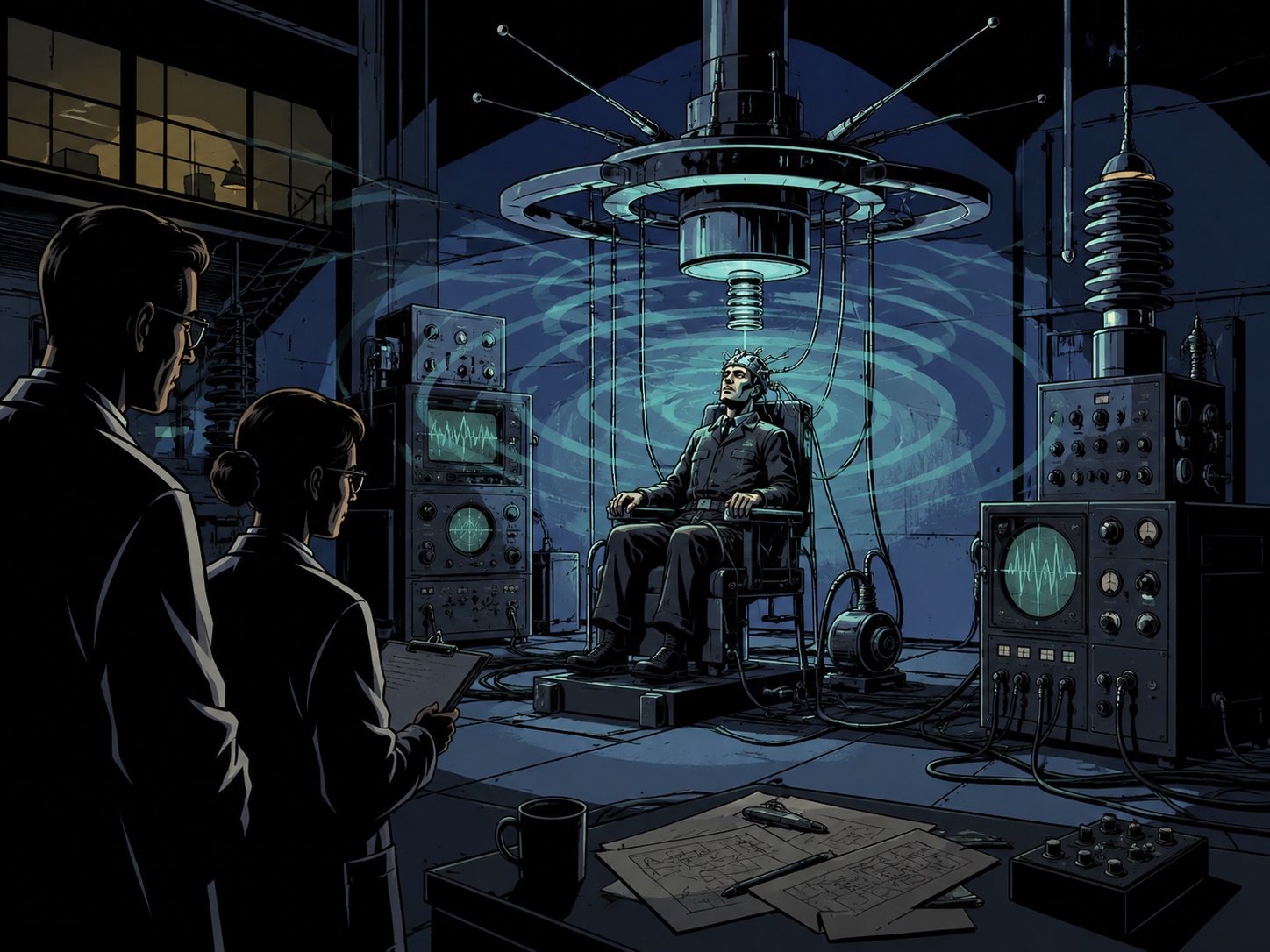
Treat the anomaly like hostile intelligence. Verify sources. Preserve samples. Record chain of custody. Ask who benefits from belief. Use Medicine for exposure, Knowledge for program history, Cyber or Cryptography for signal anomalies, Interrogation for subject debrief, and Tradecraft for keeping the file compartmented.
Do not assume the strange thing is true. Do not assume it is false. Both assumptions are exploitable.
GM Guidance
Keep the module ambiguous unless the table explicitly wants confirmation. An Anomalous File should feel like a locked cabinet in the Cold War basement: ugly, expensive, over-classified, and full of human cost. The most useful reveals are not “psychics are real.” They are “the KGB believed this enough to kill three people,” “D5 buried the medical results,” or “the AI did not predict the operative; it bought the data from someone inside the station.”
Example: Department V
A 1978 file claims a Soviet psychotronics unit predicted the death of a D5 asset in Vienna. The team investigates. The anomaly may be false. The asset may have been compromised by ordinary surveillance. The prediction may be a forged document planted to identify who inside D5 asks about Department V. The operation works either way: the target is not the paranormal claim, but the hostile program using the claim as cover.
Using This Chapter
Seeding a Nemesis
A Nemesis should never arrive in the campaign without preparation. The rule of thumb is three foreshadowing operations before first direct contact. These can be subtle: a reference in a dossier, a captured asset who mentions a codename, a pattern in a series of botched operations that the Analyst begins to recognize. The foreshadowing does two things: it establishes the Nemesis as real before they become a scene-partner, and it lets the players earn the narrative payoff of recognizing the Nemesis when they finally meet.
The foreshadowing sequence for a Nemesis generally runs:
- Reference. The Nemesis’s name, codename, or signature appears in a file. The players may not notice.
- Implication. A subsequent operation goes wrong in a way that reflects the Nemesis’s methods. The players will usually notice now.
- Confirmation. A captured opponent, a defector, or a sympathetic Handler explicitly names the Nemesis as the figure behind the operations.
- Contact. The Nemesis appears, in a room of their choosing, on terms they have set.
Adversary Scaling
A Nemesis as written is calibrated for a four-to-six-operative team at early-to-mid campaign power level. For larger teams or later-campaign play, apply the following adjustments:
Team of Seven or More. Add two Elites to the Nemesis’s network per session featuring them. Do not increase the Nemesis’s own statblock.
Late-Campaign Team. The Nemesis gains one additional Signature Move, selected from any Elite in the opposing service (an Architect at late-campaign level might acquire a Cyber-Intel Analyst’s Pattern Match ability; a Shcherbakov at late-campaign might acquire a Cleaner-style retroactive-presence ability).
Boss Fight. The Nemesis is played with full environmental support: their entire network, their signature move, and at least one Elite in direct backup. A properly-scaled Nemesis confrontation should not be survivable by a team that has not prepared for it. It should be survivable by a team that has.
Adversary Retirement
Sometimes a Nemesis is defeated: killed, captured, or narratively resolved in a way that makes their continued presence untenable. When this happens, the GM has three good options:
Retire the Nemesis entirely. Close the file. The campaign moves on to the next arc.
Replace the Nemesis with a successor. Der Falke’s deputy inherits his files; Shcherbakov’s protegé takes his department; Meridian promotes Vale’s second-in-command to CEO. The successor is mechanically similar but narratively distinct: this is how a campaign maintains continuity across multi-season play.
Reveal the Nemesis was a front. The Nemesis the team defeated was a cut-out, a deliberate misdirection, or a patsy installed to protect the real power behind the operation. This is the John le Carré move. Use it sparingly, and never more than once per campaign. When it works, it redefines the campaign; when it does not, it feels like a cheat.
A Final Note on Adversary Respect
Every adversary in this chapter is designed to be defeated: that is the purpose of a villain. But adversary respect is one of the things that separates a Division 5 campaign from a generic thriller. In play, give each adversary one habit, one loyalty, and one thing they would rather be doing, and portray those straight; the dossiers in this chapter model the approach.
That texture is what makes defeat mean something, not a softening of the villains. An operation that kills Der Falke is a decision the operative will think about at three in the morning for the rest of their career, not a high-five moment. The game works when the table takes that seriously. The game collapses when it does not.
In This Chapter
- Minion, Elite, and Nemesis framework
- Era-tagged Minion group pools
- Civilian and institutional NPC templates
- Elite officers, including the Cleaner
- Nemesis dossiers: Der Falke, Shcherbakov, the Architect
- Opposing services and the rival off-books
- Threat environment and hostile cities
- Optional module: Anomalous Files
- Compromise-rate environment modifiers
- Seeding, scaling, and retiring Nemeses