Character sheet Operative Dossier One-Page Dossier
Pick a profession. Pick a stance. Pick a cover story you can defend under interrogation.
The operative you build today is the operative you will play until they are burned, buried, or quietly pensioned off to a safe house in Portugal. Make them someone you can live with for the length of a campaign. Make them someone the other players can sit across from at the table. Make them someone the Division would, on a calm afternoon, actually hire.
And then, because this is the profession it is, make them someone whose real name is not on this sheet, and whose real reason for being in this line of work is one you might not share with the rest of the table until the right session comes.
A Word on Species
Every character in Division 5 is human. This is a real-world Universe; the only species on the board is ours. The Exodus NDS framework usually uses a species layer for mechanical differentiation and a shtick layer for narrative identity. In Division 5, both layers remain, but they are re-purposed: Archetype takes over the mechanical layer, six professional specializations answering “what does this character do?“; Disposition takes over the narrative layer, six one-sentence locked identities answering “who is this character, at the level that cannot be retrained?”, drawn from the psychological profile of the intelligence trade.
Every PC has exactly one Archetype and one Disposition, each locked once picked (see Step 2 and Step 3). This re-purposing extends to the build sequence itself: Division 5 replaces the Core Rules’ default species/background/career purchase sequence, building characters instead from Archetype, Disposition, Legends, Requisition, and Tradecraft Tree choices.
The Nine-Step Character Creation Flow
Division 5 uses a bespoke character creation procedure. Do not start with the Core Rules’ 110 XP build unless the GM is deliberately running a conversion campaign.
Run these in order. Each step feeds the next.
- Pick your Era (a table-level decision: Shadow War, Long Dark, or Nightscreen).
- Pick your Archetype (mechanical profession: one of six).
- Pick your Disposition (narrative identity: one of six).
- Assign Characteristics per the Exodus NDS Core Rules, modified by Archetype.
- Assign Skills from the list in Chapter Four.
- Pick Starting Talents from Chapter Five, including your first pick in your era’s Archetype Tradecraft Tree.
- Build your Legends: your cover-identity stack (first pass; full rules in Chapter Eight).
- Requisition Starting Equipment from the era-appropriate catalog in Chapter Six.
- Finishing Touches: name, codename, tell, and one secret that would end your career.
The rest of this chapter walks through each step. Steps 4, 5, 6, and 8 reference other chapters for the rules.
Before You Build
Four conversations to have before anyone picks an Archetype:
The era. One era per campaign is the default. See Step 1 below for the three options; Chapter Two covers each in depth and Chapter Eight covers their mechanical modifications. Pick now. Everything downstream depends on it.
The tonal dial. Le Carré or Fleming, or somewhere in between. The group should agree on a register before characters are built: Fleming-register characters built for a Le Carré campaign will feel out of place and vice versa. Chapter Eleven has sliders for this; the short version is how stylish and action-forward do we want this, versus how procedural and bleak?
Lines and veils. Division 5 is a Universe in which interrogation, compromise, moral failure, and the occasional dead asset are baked into the mechanics. Tables should agree up front on what content they want fully on the table, what they want acknowledged but skimmed, and what they want avoided entirely. The Universe works without any specific taboo being invoked, a campaign can have extensive interrogation with no on-screen torture, for example, but the table needs to know where the lines are before the first session.
The team shape. Coverage across the team matters more than which six Archetypes get picked individually. See the Team Composition Notes sidebar under Step 2 for the balance guidance and the tradeoffs of stacking one Archetype.
On Character Names
D5 characters carry multiple names, real, service, codename, and cover, and the real name in particular does not need to be shared with the table; see Step 9: The Name for the full breakdown.
Step 1: Pick Your Era
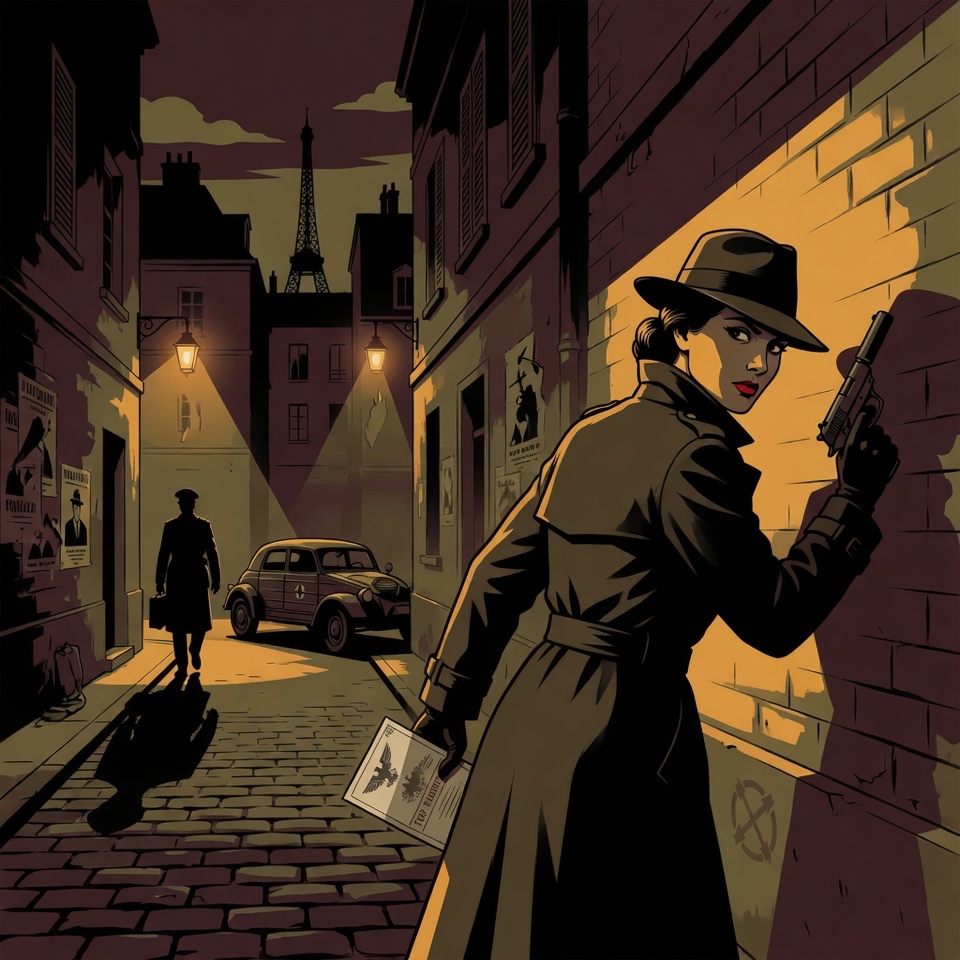
A table-level decision, ideally made at session zero before anyone begins building a character. The era determines which equipment catalog is used (Chapter Six), which vehicles are available (Chapter Seven), which rule modifications apply (Chapter Eight’s Era Framing), and, most importantly, what kind of stories the table will be telling.
- Shadow War (1939–1945). Deadly, short, high-attrition. Combat-forward relative to the other eras. Legends build and burn fast. Operatives die or retire within a year or two of in-fiction time. See Chapter Two for the full era profile.
- Long Dark (1946–1989). Patient, procedural, morally dense. Tradecraft is king. Legends build at standard speed and can be rested between operations. Operations are slow; relationships are central. The default Division 5 register.
- Nightscreen (1990–present). Technologically dense, geopolitically messy, attribution-driven. Cyber is a primary skill. Deep Legends take years to build. The modern theater, and the era where the private sector is most prominent.
If the table is undecided, the Long Dark is the strongest first campaign. Its rules modifications are the most balanced, its tonal register is the one the system was most explicitly built for, and its tradecraft is continuous with both neighboring eras if the table later wants to shift or expand.
Step 2: Pick Your Archetype
Each Archetype is a starting characteristic array, a signature passive ability, a starting skill set, a set of recommended talents, and a position on the team. Six options. Pick one. You cannot change it during the campaign without a major fictional justification.
Every Archetype is available in all three eras. Flavor text below is calibrated for the Long Dark as the neutral register; era-specific notes call out the Shadow War and Nightscreen variants where relevant. Iron Nerve (Tier 1) is a strong first pick for any Archetype; the Recommended Talents lines below call out the picks that actually differentiate one Archetype's build from another's.
Characteristic Array Format
Each Archetype lists its baseline characteristic array, using the six characteristics Might, Agility, Intellect, Savvy, Willpower, Charisma. Their uses are defined in the Core Rules; the Division 5 register does not modify them. Reassignment rules for personalizing the array appear in Step 4.
Starting Skills Format
Each Archetype lists three tiers of starting skill picks:
- Class Skills (Rating 2 each). Three skills from the Archetype’s professional competency set. These are the skills the character learned during D5 training. Every character receives all three at rating 2.
- Free Picks (Rating 1 each). Three additional skills at rating 1, player’s choice from the full skill list.
- Optional Signature Skill. One Class Skill the player may advance instead of one free pick to rating 3, representing the character’s personal emphasis beyond standard training.
The Six Archetypes at a Glance
| Archetype | Role | Signature Ability | Prime Stats |
|---|---|---|---|
| Operative | Field generalist | Jack of All Trades | Agility / Savvy |
| Handler | Asset runner | Asset Network | Charisma / Willpower |
| Analyst | Intelligence brain | Pattern Recognition | Intellect / Savvy |
| Face | Social infiltrator | Cover Artist | Charisma / Savvy |
| Wetworker | Quiet specialist | Lethal Option | Agility / Willpower |
| Quartermaster | Gear-maker | On the Bench | Intellect / Agility |
Team Composition Notes
A well-balanced team of 4 PCs often looks like:
- One Operative or Handler as the field lead.
- One Analyst or Quartermaster as the intel-and-tech pillar.
- One Face or Handler as the social-approach specialist.
- One Wetworker or Operative as the edge for the rare kinetic scene.
A team of 3 PCs can collapse two of these into combined roles. A team of 5+ can double up on a specialty. No Archetype is required, though a team stacked entirely on one Archetype runs into trouble: five Wetworkers make for a short, loud campaign, and five Analysts make for a thoughtful one that needs an excellent GM to keep it moving. See the Step 5 sidebar for the Tradecraft/Surveillance coverage every team needs.
Two characters of the same Archetype is otherwise fine. Two Wetworkers will both feel underutilized most sessions and essential when things go loud. Two Analysts will have distinct research specialties. Two Faces will have complementary covers. The mechanics do not punish duplication; the fiction usually doesn’t either.
The Operative: “The All-Rounder”
The field generalist. Trained in a bit of everything, expert in nothing. The Operative is the spine of any D5 team: the one who crosses borders, runs meetings, holds cover, improvises at speed, and does the job when the specialists are out of position. Never the best in the team at any one thing, the Operative is the one who gets things done anyway.
Era flavor. Shadow War Operatives are the SOE-OSS field officers who did everything that needed doing and nothing that got into print. Long Dark Operatives are the Moscow-Rules-fluent street officers who ran the low-visibility work of the era. Nightscreen Operatives are the generalists who somehow still exist in a profession that increasingly demands narrow specialization: the rare generalist is, in this era, more valuable than ever.
Signature: Jack of All Trades. Once per scene, the Operative may make any skill check at one difficulty lower than the GM initially set. Declare the use before the dice are rolled. This applies after all other modifiers and may be used with any skill, including ones the Operative has rating 0 in. The Operative represents what it looks like when a trained professional finds the most efficient path through a situation that was not obviously in their specialty.
Baseline Characteristic Array.
Class Skills (Rating 2 each). Tradecraft, Perception, and one field-action skill (player’s choice: Brawl, Melee, Ranged, Sniping, or Survival & E&E).
Free Picks (Rating 1 each). Three skills of the player’s choice from the full list.
Recommended Talents (Chapter Five). Moscow Rules (Tier 2, if pursuing the tradecraft emphasis).
Starting Equipment Notes. Standard field kit for the era. The Operative’s strength is versatility, not specialization; requisition should be balanced rather than weighted toward any single category.
The Handler: “The Runner”
The asset-runner. The station-chief-in-training. The officer who turns civilians into assets and keeps them alive long enough to produce useful intelligence. The Handler’s professional life is a sequence of long patient relationships with people who are, for various reasons, doing something that could get them killed, and the Handler’s job is to ensure that the risk they take is worthwhile, survivable, and directed toward the operation that matters.
Era flavor. Shadow War Handlers worked with Resistance cells, running networks of French or Yugoslavian partisans whose loyalty was won on the ground and paid in blood. Long Dark Handlers are the signature D5 role of the era, the officer who cultivates an asset in a Warsaw Pact ministry over eighteen months and runs them for ten years afterward. Nightscreen Handlers work with defectors, disaffected professionals, and the occasional non-state-actor asset, the relationship work is the same; the people change.
Signature: Asset Network. At the start of each operation, the Handler may name one off-screen contact in the area of operations: a bartender who owes them a favor, a former asset who retired cleanly, a journalist on a regional payroll. The contact is established as a free narrative fact. The contact may be called upon once per operation for a specific favor within their plausible capability (a discreet lift, a piece of local information, a warning about a person). Repeated use of the same contact across operations is possible but requires GM approval and may develop into an ongoing relationship.
Baseline Characteristic Array.
Class Skills (Rating 2 each). Charm, Leadership, and Negotiation.
Free Picks (Rating 1 each). Three skills of the player’s choice. Tradecraft, Streetwise, and Deception are the most commonly chosen.
Recommended Talents (Chapter Five). Cold Closer (Tier 2). Recruiter (Tier 1) is the common Tradecraft Tree pick at creation.
Starting Equipment Notes. The Handler’s gear is social: a well-tailored wardrobe, a couple of specific items (a good lighter, a reliable pen, a pocketable notebook), and one piece of communications gear tuned for asset contact. They do not typically carry weapons on a first meeting; they sometimes do on a subsequent one.
The Analyst: “The Brain”
The intelligence professional in the narrowest sense. The Analyst reads. The Analyst reads everything. The Analyst finds the thread in the dossier that the three people before them missed, notices the inconsistency in the asset’s cover story that the Handler has been overlooking, and, when the rest of the team is in the field, stays in the safe house in front of a map or a monitor or a stack of transcripts and calls in the detail that saves the scene.
Era flavor. Shadow War Analysts are the codebreakers and dossier-readers in the Nissen huts, the women and men who did the war’s intellectual labor far from any bullet. Long Dark Analysts are the desk-rangers, the Langley, the Century House, the Vauxhall Cross officers who spent careers reading traffic. Nightscreen Analysts are the data professionals, the ones who can read a gigabyte of metadata and tell you three true things about a target, plus one guess that usually turns out to be correct.
Signature: Pattern Recognition. Once per session, the Analyst may ask the GM one direct question about the current operation. The GM must answer truthfully, in as much useful detail as is fair to the question asked. Typical examples: “Is the asset working for another service?” “Is the rendezvous location actually secure?” “Is the information in this dossier accurate?” “Who is the real principal behind this contract?” The question is resolved by the GM narratively; dice are not rolled. The declaration is the use.
Baseline Characteristic Array.
Class Skills (Rating 2 each). Knowledge (Geopolitics), Perception, and Cryptography.
Free Picks (Rating 1 each). Three skills of the player’s choice. Cyber (Nightscreen), Surveillance, and Forgery are common picks.
Recommended Talents (Chapter Five). Ledger Sense, a Universe-unique talent giving +1 Boon die on Ledger Queries, is a strong pick.
Starting Equipment Notes. The Analyst’s gear is quiet. A good notebook, a fountain pen, a reliable radio or laptop appropriate to the era, a pair of reading glasses that look civilian and are not entirely civilian. An Analyst carries a firearm rarely and only under cover.
The Face: “The Charmer”
The social infiltrator. The Face wins by being invited inside instead of breaking in. Cover identities are the Face’s natural medium, the Face can wear a Legend longer, adapt it under pressure, and step into a new Legend faster than any other Archetype. The Face is the honeypot, the diplomat, the charming con artist with a cover as an art dealer, the character who walks into a gallery opening and leaves with an invitation to a weekend in Provence with the target.
Era flavor. Shadow War Faces were often embedded with the occupied-country intellectual and artistic classes, the British officer passing as a Belgian wine merchant, the French officer as a collaborationist journalist. Long Dark Faces are the signature case officers of Vienna and Beirut, cultivating relationships in salons, cafés, and university faculties over years. Nightscreen Faces work in the gray-zone cocktail circuit of Dubai, Singapore, and Zurich, where a well-maintained cover and a plausible professional identity can open doors that no kinetic approach would.
Signature: Cover Artist. Every Face Legend takes one additional Burn Track box, and the Face begins play with an extra Standard Legend. Full numbers are in Step 7: Build Your Legends. This is the strongest cover capability in the game.
Baseline Characteristic Array.
Class Skills (Rating 2 each). Charm, Deception, and one of Streetwise or Disguise.
Free Picks (Rating 1 each). Three skills of the player’s choice. Negotiation, Perception, Streetwise, and Tradecraft are common picks.
Recommended Talents (Chapter Five). Cold Closer (Tier 2).
Starting Equipment Notes. The Face’s equipment is the cover itself: clothing, documents, a well-built paper trail. A Face requisitions a higher-than-average share of their budget into cover infrastructure and a lower share into weapons and tools. A Face carrying a visible weapon is a Face who has lost the scene.
The Wetworker: “The Specialist”
The quiet specialist. Sabotage, close protection, targeted action, counter-terror, and, when the operation demands it, assassination. The Wetworker is the Archetype with the most blood on the ledger. Most Wetworkers are not comfortable with this fact. A Wetworker who is comfortable with it is a Wetworker the institution watches carefully.
Era flavor. Shadow War Wetworkers are the SOE demolitions experts dropped into a valley to derail a train and disappear on foot, carrying the Sykes-Fairbairn knife and the Welrod silent pistol with a working acquaintance with plastic explosives. Long Dark Wetworkers are the special-mission officers kept on the bench most of the time and deployed when the work cannot be deniably handled by anyone less professional, the KGB-counterpart operators who did the work neither side wanted in print. Nightscreen Wetworkers are the tier-one operators on permanent loan, or the deniable private-contractor equivalent, direct-action specialists who can draw on modern precision weaponry and, increasingly, hybrid cyber-kinetic tools.
Signature: Lethal Option. Once per scene, when the Wetworker makes a violent action, they may compress the setup around that action. They may take one additional Maneuver tied directly to the violence without spending Strain: draw a weapon, close one range band, take cover for the shot, set a charge, seize a target, or ready the tool that makes the attack possible. If the violent action would reasonably require two Maneuvers and an Action in the same turn, Lethal Option covers one of those Maneuvers; the Wetworker must still pay the normal cost for the other Maneuver and must still spend the Action. This represents immediate kinetic training, not a second attack. Using it creates the usual Compromise, Public Heat, and attribution consequences for violence.
Baseline Characteristic Array.
Class Skills (Rating 2 each). Ranged or Sniping, one additional Combat skill (player’s choice: Brawl, Melee, Ranged, or Sniping; do not choose the same skill twice), and Stealth.
Free Picks (Rating 1 each). Three skills of the player’s choice. Athletics, Resilience, Survival & E&E, Demolitions, and Tradecraft are common picks.
Recommended Talents (Chapter Five). The Wetworker is the one Archetype that has real uses for additional Combat talents: Combatives, Long Eye, Signature Weapon, and similar picks in Chapter Five.
Starting Equipment Notes. The Wetworker gets first pick of the era’s weapons catalog. A Shadow War Wetworker starts with a Welrod and a Sykes-Fairbairn; a Long Dark Wetworker with a suppressed Makarov or High Standard HDM; a Nightscreen Wetworker with a PSS silent pistol, a knife, and a set of covert breaching tools.
The Quartermaster: “The Tech”

The gear-maker and gear-breaker. The Quartermaster’s value on a team is constant deployment: whatever the mission needs, the Quartermaster can build, repair, or improvise. This Archetype is the reason D5 teams rarely find themselves tool-blocked in the field.
Era flavor. Shadow War Quartermasters are SOE armorers filing down serial numbers, improvising silencers from brake cleaner and steel wool, and teaching field operatives how to service a Sten in the dark: the Inter-Services Research Bureau technicians and OSS Research & Development gear-makers who made the escape maps printed on silk, the one-shot pistols disguised as pens, the suicide pills in hollow signet rings. Long Dark Quartermasters run a back-room workshop behind a Viennese optician, building specialized cameras, microphones, and the occasional weapon: the “Q Branch” archetype at its classic peak, the concealed-camera builders, the hollow-coin specialists, the lockpick-set engineers.
Nightscreen Quartermasters are hardware hackers with three burner laptops, a soldering iron, a 3D printer, and a workspace full of devices they have modified or built from scratch: maker-engineers with a strong Cyber overlap. The line between a Quartermaster and an Analyst sometimes blurs in this era, and many teams run a Quartermaster-Analyst combo.
Signature: On the Bench. Once per operation, the Quartermaster may introduce one piece of standard equipment from the era catalog into the current scene that was not requisitioned in advance. The declaration is: “I built this before we deployed.” The item must be era-appropriate, portable, physically plausible to have carried, and Requisition Cost 3 or lower. It cannot be a vehicle, a major explosive, a prototype, a Black item, a mission-objective item, or a piece of gear whose presence would erase the central problem of the scene. This represents the Quartermaster’s habit of building contingency gear and bringing it along “just in case,” not an unlimited requisition bypass.
Baseline Characteristic Array.
Class Skills (Rating 2 each). Engineering & Repair, Forgery, and one of Coordination, Demolitions, Cryptography, or Cyber (era-appropriate; Cyber in Long Dark is a niche pick, not a standard one).
Free Picks (Rating 1 each). Three skills of the player’s choice. Coordination, Perception, Tradecraft, and Drive are common picks.
Recommended Talents (Chapter Five). The Quartermaster benefits from Universe-unique talents that extend requisition, reduce gear-building time, or expand the equipment catalog.
Starting Equipment Notes. The Quartermaster gets the widest starting equipment catalog of any Archetype: they essentially build or modify their own kit. At creation, the Quartermaster receives their standard Requisition Budget plus one additional piece of gear marked as modified, which the GM and player design together.
Step 3: Pick Your Disposition
Dispositions are Division 5’s version of Ink & Mayhem’s Shtick layer: a one-sentence identity naming the non-negotiable center of the character’s psychology in this line of work, distinct from profession, background, and mood.
Each Disposition produces two interlocking dice effects:
- In-Disposition Play: when the player can demonstrate that an action, choice, or scene aligns with the Disposition’s central belief, the GM adds +1 Boon die to the resulting check (or to the dramatic beat if no check is rolled).
- Against-Disposition Play: when an action or situation forces the character to act against their Disposition, any Trial dice in the roll are upgraded to Crisis dice for that check. The character is not worse at the action; the character is riskier at it: the fiction has more room to go sideways.
Dispositions are locked at creation. A character cannot change their Disposition during a campaign without a substantial in-fiction event: typically a campaign-defining beat that the GM and player agree has genuinely reshaped the character. Even then, Disposition change is rare.
The Six Dispositions
Every character picks one. Below, each is given its anchor sentence, its tonal description, the kinds of scenes where it is in Disposition, the kinds of scenes where it is against Disposition, and a short note on campaign implications.
The Patriot
Anchor: “I believe in the flag, even when the flag does not believe in me.”
You are in this work for the country, the cause, the oath you swore to something larger than any one mission. You do the ugly work because somebody has to, and you tell yourself, some nights more convincingly than others, that the ledger balances in the end. You are not naive. You have seen your service lie to its own citizens, sacrifice its own assets, and abandon its own officers; you have, personally, done ugly things at the institution’s instruction. None of that has cracked the underlying commitment, because the commitment is to the flag beneath the institution, and the people beneath the flag, not to the institution itself.
In Disposition. Acting in service of the mission or the asset when personal cost is high. Following lawful orders through moral difficulty. Protecting civilians at operational risk. Choosing the operation over the operative.
Against Disposition. Acting against institutional interest for personal gain. Abandoning an asset to save yourself when the institution expects otherwise. Taking money from a foreign service. Participating in an operation the Patriot believes is fundamentally illegitimate.
Campaign notes. Patriots age badly in the institution. The first few campaigns run cleanly. The later ones, after they have seen enough, require the player to either hold the commitment deliberately (through visible effort) or acknowledge its erosion. A Patriot whose commitment has quietly cracked but who keeps the surface makes for a genuinely interesting character study.
The Professional
Anchor: “This is a job. I do it well. I go home.”
The detached craftsman. The operative who has consciously set aside ideology, patriotism, revenge, and personal investment, and who operates instead out of the simple professional pride of doing a difficult job well. The Professional does not ask whether the mission is just. The Professional asks whether the mission is possible, and if it is possible, executes it with the full weight of their training. Home, when it comes, is a quiet flat, a partner who does not know the real work, a drink at the end of the day, and the sense that one more operation has been delivered without a client complaint.
In Disposition. Executing a complicated operation cleanly. Refusing to be drawn into ideological argument. Maintaining emotional distance from the asset while treating them with professional courtesy. Walking away from a job when the parameters make it impossible. Taking pride in tradecraft rather than outcome.
Against Disposition. Allowing personal feelings to alter operational judgment. Acting out of anger, grief, or revenge. Abandoning the standards of the craft under pressure. Becoming emotionally entangled with an asset or colleague to the point that the operation is compromised.
Campaign notes. Professionals are the Universe’s most survivable Archetype-agnostic personality: they last, and they rarely produce dramatic retirements. Good Professional players give their characters small private eccentricities, unexpected preferences, quiet personal stakes that exist underneath the professional surface.
The Cynic
Anchor: “I stopped believing years ago. I stayed anyway.”
You have seen too much. The agencies lie. The assets burn. The allies trade you for better terms. Every operation has collateral that the operation’s official account does not mention, and every colleague you trusted once has, at some point, looked at you across a room in a way that makes clear they are calculating the price of your loyalty. You are still in the field because leaving is harder than staying; because the alternative is worse; because somebody has to be the adult in the room; because the work is the work and the work is what you know how to do.
In Disposition. Anticipating betrayal and planning around it. Making the hard, pragmatic call the more idealistic operatives cannot make. Accepting dirty outcomes that a Patriot or Idealist would resist. Protecting teammates without sentimentality. Recognizing a lie early.
Against Disposition. Acting out of genuine hope. Trusting a new contact on the strength of their word. Taking an operation on because “it is the right thing to do” with no other justification. Allowing emotional attachment to override operational judgment, not because the Cynic lacks emotion, but because they have trained themselves against its operational expression.
Campaign notes. A Cynic’s cynicism plays best when it is earned: specific betrayals, specific losses, specific seasons that broke specific beliefs. A clear backstory of what they used to believe is what makes the Disposition read as three-dimensional at the table. The Cynic is also the Disposition most often caught in a genuine moment of hope; when that happens, let the scene breathe.
The Idealist
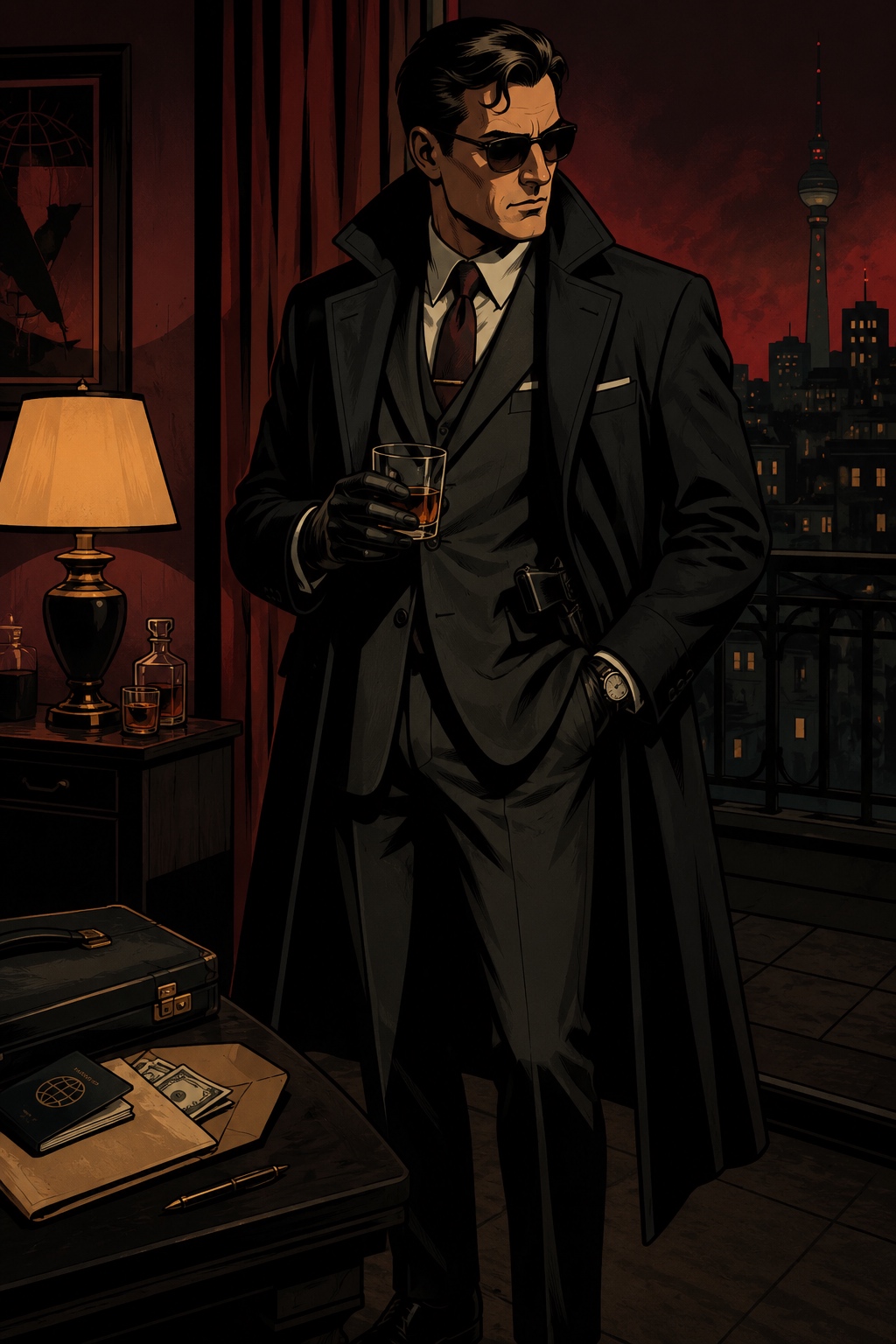
Anchor: “I can still make this worth it.”
You believe, sincerely, that the work changes the world. Each operation, each asset saved, each file delivered intact is a brick in something better than the present. You are not naive about the cost, you have seen what it costs, you have paid a share of the cost yourself, you have buried colleagues, but the underlying conviction remains that this work, done well, leaves the world slightly less bad than it would otherwise be. Your colleagues find this exhausting. You find their cynicism unforgivable in a way you mostly keep to yourself.
In Disposition. Volunteering for operations of moral weight. Advocating for the asset’s interests inside the institution. Refusing to normalize the institution’s ugliest practices. Extending unwarranted trust to a desperate contact. Pushing an operation toward a just outcome when an expedient one is available.
Against Disposition. Doing expedient evil “because the mission requires it.” Accepting institutional betrayal as ordinary. Participating in an operation that is morally compromised at its root without protest. Abandoning an asset because the calculus says the asset is expendable.
Campaign notes. The Idealist is the rarest Disposition in the profession’s internal imagination, most veterans believe Idealists do not survive ten years in the field without converting to Cynics. The GM should honor this by making Idealism cost across the campaign. An Idealist who is still Idealist at session 40 has earned it. The Disposition works best in a campaign that has moral stakes, there must be actual wrongs the Idealist can refuse to be part of, or the Disposition floats without traction. Idealists who survive the long run stay memorable precisely because survival-with-intact-idealism is the hardest outcome in the profession.
The Mercenary
Anchor: “Who’s paying this week?”
You are in this for the money, the access, the thrill, the escape from the life before, the interesting travel, the professional acquaintance of interesting dangerous people: whatever keeps you showing up. You may have come in through a patriotic door originally; you may have come in through a recruitment pitch that emphasized compensation; you may be, officially, on D5’s books and, unofficially, on three others’. D5 does not mind the motivation. D5 minds the performance, and you always perform.
In Disposition. Taking an operation because it pays. Negotiating hard for your own compensation or rewards. Maintaining a working relationship with multiple paymasters. Treating the work transactionally: delivering exactly what was paid for, no more, no less. Leaving a job cleanly when the paymaster becomes unreliable.
Against Disposition. Taking an operation for no compensation out of conviction. Refusing pay. Taking a substantial personal risk for no return. Staying on a job after the paymaster has burned the operative: a Mercenary who does not leave is a Mercenary whose Disposition is under pressure.
Campaign notes. A Mercenary’s transactional surface works best when it covers a real set of personal loyalties: to specific colleagues, specific assets, specific places. The contract with the institution is not the only contract in their life; it is only the one they let the institution see. The best Mercenary campaigns put that private loyalty under visible strain, when the paymaster asks for something the private Mercenary would not do, and the player has to decide which side of the contract wins.
The Ghost

Anchor: “I was burned. I should be dead. Yet here we are.”
You are off-book even within an off-book service. Disavowed, disowned, officially deceased, or simply gone, and then, against your expectation, reactivated. You have no family ties the institution knows about, no personal life outside the work, no forward-planning beyond the current operation. You are here because you are one of the few people at this table the institution can genuinely deny ever having known, and because D5 sometimes needs exactly that.
The Ghost is Division 5’s version of the permanently broken operative: someone whose past career has, for one reason or another, made them unusable to any normal intelligence service and perfectly suited to the deniable margin. Some Ghosts are former officers of other services who were betrayed and survived. Some are former assets who converted. Some are operatives whose original identities were buried by the institution for operational reasons.
In Disposition. Operating alone. Taking risks a connected operative could not. Disappearing cleanly from a scene. Accepting deniable operations the rest of the team is not authorized for. Refusing ties to place, person, or institution.
Against Disposition. Forming genuine attachments. Refusing deniable work in favor of ordinary cover identity. Operating under a non-deniable Legend. Returning to a former identity. Requesting institutional support that is formally documented.
Campaign notes. The Ghost is the most structurally fragile Disposition, every Ghost has a story of how they got here, and the story almost always haunts the campaign. Ghosts benefit from slow reveal: the player and GM design the Ghost’s backstory together, agree on what will come out and when, and let the reveal land across several sessions. A Ghost who has no attachments at session 1 but has developed one careful attachment by session 20 is a Ghost whose Disposition is alive, not violated, the attachment is the pressure the Disposition is holding against. When the pressure finally breaks, or does not, the moment pays off the setup.
Mixing Dispositions
A single Disposition can be played in many ways. Two Patriots at the same table will not play the same; the anchor sentence is shared, but the texture underneath differs. Two Cynics will disagree about which betrayals broke them, and those disagreements are good table material. Played as pure type, with no variation, any Disposition flattens into a stock character; the campaign notes above flag what makes each one distinct in practice.
More than one character can share the same Disposition on a single team. It is not the most interesting composition, a team of all Professionals will be tonally flat, but it is not forbidden. The classical Le Carré composition is a mix of Professional, Patriot (mostly ironic), and Cynic. The classical Fleming composition is a Professional or Mercenary with one Idealist and one Ghost on the fringes. Neither is correct; both produce good campaigns.
The mechanical effect of Disposition (see the dice effects above) is small but persistent. Across a campaign, these mechanical nudges accumulate into a coherent set of narrative pressures. Players should expect the Disposition to shape their character over many sessions even without any conscious effort to play to it: the dice do the work quietly.
On Disposition Drift
Some tables will find, over a long campaign, that a character’s Disposition is drifting: a Patriot slowly becoming a Cynic, an Idealist slowly becoming a Professional, a Ghost slowly developing attachments that make the Disposition visibly strained.
This is good play. Do not force a mechanical Disposition change unless the player wants one. Let the drift happen in the fiction. The mechanical Disposition remains fixed; the character living through it is the one the player is actually playing.
A Disposition change may eventually be ratified by the table: a session where the shift is named, a decision point that crystallizes the change. These sessions tend to be memorable ones. Handle them with care and do not rush them.
Step 4: Assign Characteristics
Take the Archetype’s baseline characteristic array. Reassign one point as the player wishes, subject to the following constraints:
- No characteristic may drop below 1.
- No characteristic may rise above 4 at creation.
- The reassignment is a single move: one point from one characteristic to another.
This represents the character’s personal lean: the Operative who is slightly more charismatic than the baseline, the Analyst who is slightly tougher, the Wetworker who is slightly smarter. The reassignment is the place where the player personalizes the Archetype mechanically before the character fully comes into focus.
Why Only One Point
The one-point restriction is deliberate. Bigger customizations tend to produce characters that drift away from the Archetype’s intent: a Wetworker who rebuilt as a Charm-first character is probably more comfortable as a Face. If the baseline array does not fit, consider whether a different Archetype would fit better.
Derived Values
After assigning characteristics, calculate derived values exactly as in the Core Rules:
| Value | Formula |
|---|---|
| Resistance | Half Might, rounded up, plus armor or protection. |
| Wound Points | 10 + Might. |
| Strain Points | 10 + Willpower. |
| Melee Defense | 0, modified by gear, talents, or scene effects. |
| Ranged Defense | 0, modified by gear, talents, cover, or scene effects. |
Division 5 does not change these formulas. Compromise, Legend Burn, Trust, and Exposure are separate tracks; they do not replace Wounds, Strain, Resistance, or Defense.
Step 5: Assign Skills
Skills are defined in Chapter Four. Every character receives Class Skills, Free Picks, and an optional Signature Skill as defined in Step 2’s Starting Skills Format. Most characters will advance two to three skills per era (roughly, per season) of campaign play.
A character may not begin with any skill above Rating 3. Rating 4 and 5 skills are reserved for experience advancement in play, representing a career’s worth of deepening expertise rather than a starting qualification.
Skills That Every Character Should Have
Strong recommendations, based on how the Universe actually plays:
- Every character should have Tradecraft at Rating 1 at minimum, and at least one member of the team should carry it at Rating 2+. Everyone in D5 is a tradecraft practitioner, but the deeper rating is what shows up nearly every session.
- Every character should have Perception at Rating 1 at minimum, and at least one member of the team should carry Surveillance at Rating 2+. Between them, those two skills cover most of what a session throws at the party.
- Every character benefits from Readiness at Rating 1. The skill will matter the first time a quiet operation turns violent without warning.
- At least two members of the team should have Deception at Rating 2+. Cover maintenance is relentless.
- In Nightscreen, at least one member of the team should have Cyber at Rating 2+.
- Combat skills are less universal, a team can rely on one or two Wetworkers or Operatives for combat coverage, but every character should carry at least one Combat skill at Rating 1 for the scene where they must defend themselves.
Step 6: Pick Starting Talents
Talents are defined in Chapter Five, including the six Archetype Tradecraft Trees: one per Archetype, with era-flavored variants.
At creation, each character picks:
- Two General Talents from the catalog in Chapter Five or from the allowed Core Universal Talents. Starting General Talents must be Tier 1 or Tier 2 unless the GM explicitly approves a higher-tier exception at campaign start.
- One Tradecraft Tree Talent from their Archetype’s era-appropriate Tradecraft Tree, at Tier 1.
Tradecraft Tree talents advance in order (Tier 1 → Tier 2 → Tier 3, and so on), with in-fiction justification required for each step.
The Recommended Talents entries under each Archetype are suggestions for strong starting builds; players are free to pick other talents that the character qualifies for.
Advancement After Creation
After character creation, Division 5 returns to the Core Rules’ experience costs unless a campaign frame says otherwise. Skills improve by rating, talents are bought by tier and prerequisite, and derived values update normally when a characteristic changes.
Skill specializations are the D5 exception to the normal skill-rating purchase: once a parent skill is rating 2 or higher, a character may buy a narrow specialization for 1 XP with GM approval. A specialization grants +1 Boon die only inside its named scope. The optional creation signature skill that raises one Class Skill to rating 3 is separate from this rule; it increases the skill rating and does not automatically grant a named specialization unless the skill says it does.
The creation package is deliberately front-loaded: Archetype gives competence, Disposition gives pressure, Legends give cover, and Requisition gives the mission kit.
Profession Skills for Advancement
Character creation skips the Core Rules’ Background and Career step, but profession-skill advancement still applies after creation. For post-creation XP costs, a D5 character’s profession skills are:
- Every skill on the character’s Archetype Profession Skills list below.
- Every skill the character received as a Class Skill at creation, including any player-choice Class Skill.
- Every skill the character selected as a Free Pick at creation.
- One optional Personal History Skill chosen during Step 9, with GM approval, representing the character’s civilian life, pre-D5 training, or career-ending secret.
All other skills are out-of-profession skills and use the Core Rules’ higher XP costs. If a later campaign event changes the character’s actual job, reassignment to the Garden, a season embedded with a special-mission unit, years as station chief, the GM may add one or two profession skills as a downtime reward instead of granting free ranks.
| Archetype | Archetype Profession Skills |
|---|---|
| Operative | Tradecraft, Perception, Surveillance, Stealth, Coordination, Drive, Readiness, Survival & E&E, plus the chosen field-action Class Skill. |
| Handler | Charm, Leadership, Negotiation, Interrogation, Deception, Streetwise, Tradecraft, Surveillance, Readiness. |
| Analyst | Knowledge (Geopolitics), Cryptography, Perception, Surveillance, Cyber, Forgery, Tradecraft, Engineering & Repair. |
| Face | Charm, Deception, Negotiation, Disguise, Streetwise, Perception, Tradecraft, Readiness, Interrogation. |
| Wetworker | Brawl, Melee, Ranged, Sniping, Stealth, Athletics, Resilience, Readiness, Demolitions, Survival & E&E. |
| Quartermaster | Engineering & Repair, Coordination, Forgery, Demolitions, Cryptography, Cyber, Drive, Perception, Tradecraft. |
Step 7: Build Your Legends

The Legend system is defined in full in Chapter Eight. At creation, every character receives a starting Legend stack of three Legends:
- One Thin Legend. A disposable cover with three boxes on the Burn Track and roughly a week’s preparation in its backstory. Single-use flavor.
- One Standard Legend. The character’s workhorse cover, with six boxes on the Burn Track and months-to-years of backstory. This is the Legend the character will use in most operations.
- One Deep Legend. The character’s deepest cover, with nine boxes on the Burn Track and years of prepared backstory. Reserved for operations where the cheaper covers will not hold.
The Face is the exception: per the Cover Artist signature, a Face begins with two Standard Legends in addition to the Thin and Deep, for a starting stack of one Thin, two Standard, and one Deep (four total). Every Face Legend also carries one additional Burn Track box: a Thin becomes 4, a Standard becomes 7, and a Deep becomes 10.
The Ghost is a second exception: the Ghost’s Deep Legend carries one additional Burn Track box (a total of ten), reflecting the Ghost’s unusual fluency with permanent cover.
For each Legend, the player defines:
- Name (full).
- Cover profession (era-appropriate).
- Residence (specific address or city).
- Era-appropriate paper trail: detail level scales with depth. A Thin Legend needs a plausible passport; a Deep Legend needs decades of documents.
- Supporting cast: a handful of fabricated contacts. Thin Legends may have one or two; Deep Legends may have eight or more.
- Optional: up to two qualities (Aged, Networked, Transactional, Clean, Bruised, Specialized: see Chapter Eight).
The player and GM build these collaboratively. Legends are good places for the GM to seed hooks: a contact in a Legend’s supporting cast may become a recurring NPC; a Legend’s cover profession may open operational doors later in the campaign.
Step 8: Requisition Starting Equipment
Equipment is defined in Chapter Six, with three era-specific catalogs. At creation, every character receives a starting Requisition Budget scaled to their era:
- Shadow War: 20 points.
- Long Dark: 25 points.
- Nightscreen: 30 points.
Each Archetype modifies the starting budget:
- Operative: +2 points, representing their generalist versatility.
- Handler: +0 points; the Handler’s strength is people, not gear.
- Analyst: +3 points specifically earmarked for research and communications tools.
- Face: +5 points specifically earmarked for cover infrastructure (wardrobe, props, supporting documents).
- Wetworker: +3 points with first pick of the era’s weapons catalog.
- Quartermaster: +5 points, plus one modified piece of equipment designed collaboratively with the GM.
Equipment is purchased from the era catalog in Chapter Six. Each item has a point cost. Starting equipment represents the operative’s requisition at the beginning of play; subsequent operations draw on per-operation Requisition Budgets as described in Chapter Six.
A character may finish character creation under budget: the unspent points are credited as one-time “flex points” that can be spent during the first operation. This is a character-creation-only exception; normal Requisition still does not roll over between operations.
Step 9: Finishing Touches
Six important details that pin the character to the campaign.
The Name
The character has at least three names:
- Real name. The name on their D5 file in the vault. The name their parents (if known) called them. The name under which they were born, if they know it; the name under which they were buried in a previous life, if the Ghost backstory requires. This name does not have to be shared with the table. Many D5 campaigns keep real names as player-and-GM-level secrets.
- Service name. The name D5 uses internally. Often a shortened or modified version of the real name; sometimes entirely different. This is the name the Handler and other PCs use.
- Cover names. One per Legend. These are tied to the Legend build in Step 7.
For the first session, pick a service name and a single starting Legend’s cover name. The rest can be filled in as they become operationally relevant.
The Codename
D5 assigns a codename to every operative at induction. Codenames rotate on a schedule (typically every five years for active officers) to reduce the long-term risk of any single codename becoming a fixed identifier. At creation, the character has their current codename.
Codenames follow D5’s tradition of the noun + color + number format: Wolf Red Seven, Blackbird Blue Nine, Compass Grey Three. This is the institutional in-house style. PCs use their own codenames only in formal institutional communication: briefings, debriefs, dead-drop communications with HQ. Day-to-day operational work uses service names and cover names.
The player invents their codename. The GM may overrule a codename that conflicts with an existing campaign codename; otherwise, the choice is the player’s.
Codename Generator. For players who want institutional flavor without inventing, a roll-based generator appears in Chapter Ten. Typical results: Saker Gold Two, Lantern Green Five, Heron Black One.
The Tell
A tell is a small physical or behavioral habit that the character does without noticing they are doing it: lighting a cigarette the same way every time, tapping a pen against a knee when thinking, preferring one specific brand of tea, always sitting with their back to a wall.
The tell serves three purposes:
- It gives the character texture at the table. A tell is often the single most memorable thing about a PC across sessions.
- It creates opportunities for character reveal. A skilled opposition officer may notice the tell across multiple cover identities: a professional risk the character has to manage.
- It gives the GM a lever. The GM may, rarely, point to the tell in the fiction as a diegetic signal: a perceptive NPC has noticed it, and the character must decide how to respond.
Pick one tell. Keep it small. Detail is stronger than a pattern.
The Secret
Every D5 operative has at least one secret that would end their career if it became public. Usually more than one; at least one is required at creation. The secret can be:
- Operational. A decision made in the field that would not survive institutional review.
- Personal. A relationship, a child, an addiction, a former identity: something the institution does not know and would, if it knew, use against the character.
- Ideological. A belief the character holds that conflicts with the institution’s stated purpose.
- Historical. Something from the character’s life before D5 that was not fully disclosed at induction.
The player writes the secret down. The GM knows it. The other players do not know it by default: revelation, if it happens, is a campaign event.
The secret is a structural investment. It gives the GM a lever for plot. It gives the player a lens on their own character’s vulnerability. It ensures that, when the Compromise Track starts to bite, there is a specific cost the fiction can point at.
Starting Languages
Every operative begins with two fluent languages: usually a native language and one operational language appropriate to the chosen era, station, or Legend stack. Record them now. Additional languages come from the Linguist talent or from later campaign events.
If a starting Legend depends on sounding local, the GM and player should note whether the operative is Native, Fluent, or merely Working in the relevant dialect. Use the language-pressure rules in Chapter Four when speech becomes cover pressure.
Personal History Skill
Choose one optional Personal History Skill with GM approval. This skill becomes a profession skill for advancement, but it does not grant a free rank unless that skill was already selected as a Class Skill or Free Pick, or raised as the Optional Signature Skill.
The Personal History Skill should explain something from the operative’s life before D5, civilian cover, secret, or long-term professional identity: Medicine for a former field surgeon, Drive for an ex-rally courier, Knowledge (Geopolitics) for an academic recruit, Streetwise for a criminal past, Charm for a socialite Legend, or Engineering & Repair for a workshop-trained Quartermaster.
A Worked Character Creation: Evgenia Volkov
To illustrate the flow, here is a worked example. The campaign is Long Dark (Vienna, mid-1970s). The player is building a mid-career D5 officer.
Step 1: Era
The table has chosen Long Dark. The player is building to that era.
Step 2: Archetype
The player picks Handler. They want to be the asset-runner, the relationship-builder, the social center of the team.
Step 3: Disposition
After reading through the six, the player picks Cynic. Evgenia has been in the field for fifteen years. She has seen too much. She stays because leaving is harder than staying. She is, underneath the cynicism, still quietly hoping each new asset is the one who justifies the career, but she would not say that aloud, not even to her handler.
Step 4: Characteristics
Handler baseline: Might 2, Agility 2, Intellect 2, Savvy 2, Willpower 3, Charisma 3.
The player reassigns one point from Might (down to 1) into Willpower (up to 4). Evgenia is not physically imposing; she is, however, unusually difficult to break. Final: Might 1, Agility 2, Intellect 2, Savvy 2, Willpower 4, Charisma 3.
Step 5: Skills
Handler Class Skills at Rating 2: Charm, Leadership, Negotiation.
The player chooses an Optional Signature Skill and elevates Leadership to Rating 3: Evgenia is the officer the team defers to in asset-management conversations.
Two Free Picks at Rating 1: Tradecraft, Surveillance. She traded the third Free Pick for the Optional Signature Skill above.
Final skills: Leadership 3; Charm 2, Negotiation 2; Tradecraft 1, Surveillance 1.
Step 6: Talents
Two General Talents: Iron Nerve (Tier 1) and Cold Closer (Tier 2).
One Tradecraft Tree Talent: Recruiter (Tier 1, Handler’s Long Dark Tradecraft Tree).
Step 7: Legends
Thin Legend: Lena Brandt, Austrian commercial translator, flat in the 9th district. Three boxes on the Burn Track. Light paper trail. Two supporting contacts (a fictional university classmate, a fictional former employer in Graz).
Standard Legend: Margareta Keller, Swiss-Austrian art historian specializing in early modernist prints, flat in the 4th district. Six boxes on the Burn Track. Full paper trail including a doctorate from Zurich (1961), a publication record, and employment at a small Viennese gallery that is partly D5-front, partly legitimate. Four supporting contacts, including one real D5 officer posing as a colleague. Quality: Networked (the gallery, the contacts, the routine are all reachable).
Deep Legend: Irina Vasilievna Markova, Soviet-émigré journalist operating out of Paris, residence rented in Paris on a rolling lease, maintained continuously since 1968. Nine boxes on the Burn Track. Exhaustive paper trail: birth in Leningrad 1937, emigration via the Netherlands in 1959, residency in Paris since 1965, publication record in three Russian-émigré journals, real (D5-cultivated) relationships with a dozen named Parisian figures. Quality: Aged (the paper trail predates Evgenia’s career as a D5 officer by four years, having been started by another officer who retired before Evgenia even knew D5 existed).
Step 8: Equipment
Long Dark base: 25 Requisition points. Handler modifier: +0. Final: 25 points.
Evgenia’s build:
- A well-tailored civilian wardrobe (cover infrastructure), 5 points.
- A small Makarov PM pistol with two magazines, kept in a drawer at the 4th district flat, rarely carried, 2 points.
- A Minox C microdot camera, 4 points.
- A pair of one-time pads, prepared by the D5 cryptographic workshop, 2 points.
- A concealment device (a hollowed-out copy of Kafka’s Das Schloss, her favorite joke at her own expense), 2 points.
- A small collection of reliable pens and notebooks, 1 point.
- Remaining 9 points left as flex for the first operation.
Step 9: Finishing Touches
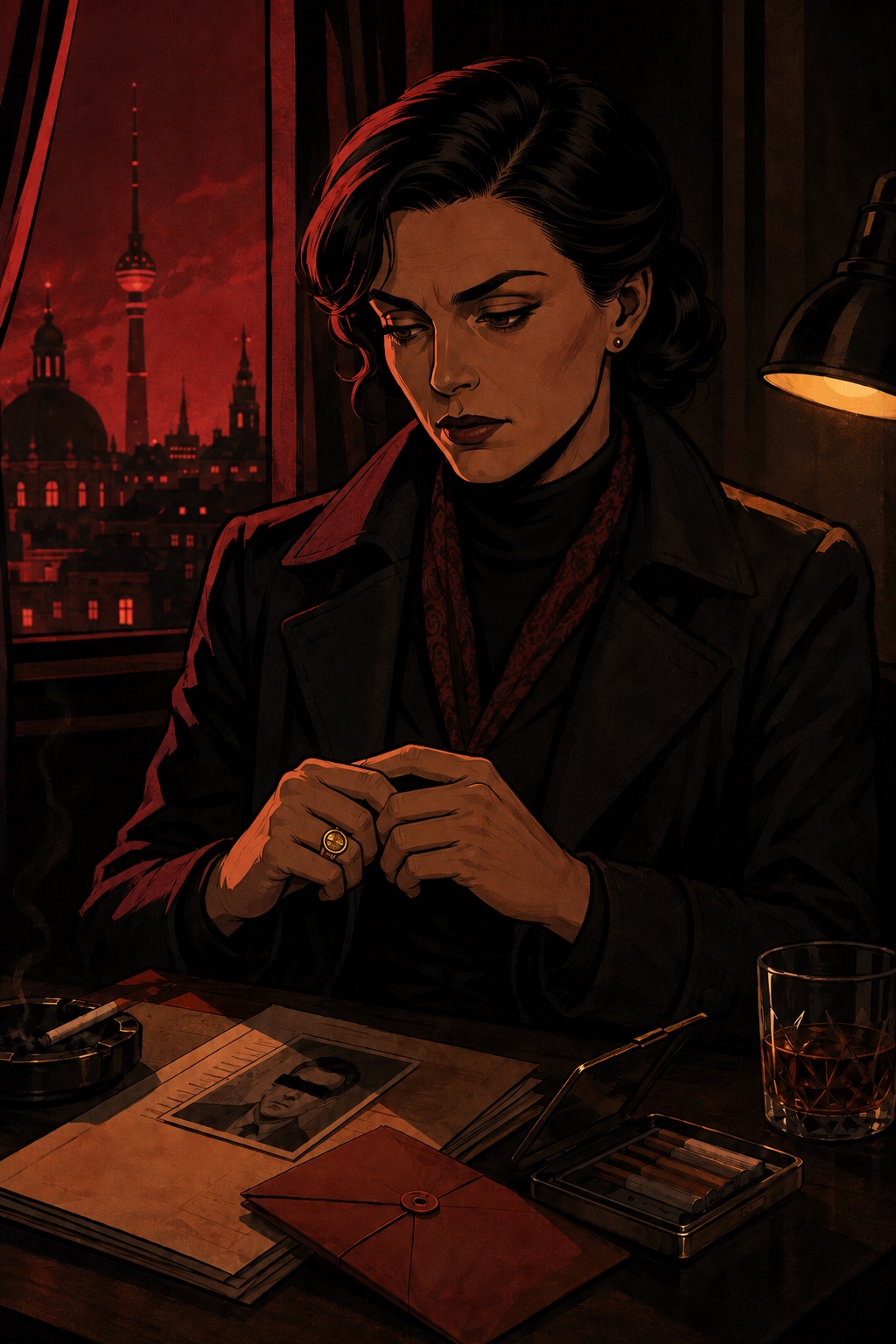
Real name: Evgenia Petrovna Volkov (the player is keeping this from the table until the right session).
Service name: Evgenia Volkov, or “E.V.” in D5 internal shorthand.
Codename: Heron Grey Four. (Current rotation; was Compass Amber Two from 1964–69.)
Tell: Evgenia, when thinking, slowly turns a signet ring on her right third finger. Three rotations, always three, always the same direction. The ring is real gold; the seal on it is a fiction of her cover. She has been doing this for eleven years and has never once noticed she does it.
Secret: In 1969, Evgenia allowed an asset to be captured. The asset had gone bad, was feeding false intelligence to the Soviets under their control, and D5 had not yet authorized termination. Rather than report the problem and wait for sanction, Evgenia arranged for the asset to be in the wrong place when the Stasi swept his neighborhood. The asset was executed three weeks later. D5 has no record of Evgenia’s role. She has no record of it either, except in her own memory, which does not let it go.
Languages: Russian and German fluent; working French from the Vienna station circuit.
Personal History Skill: Knowledge (Geopolitics), tied to her pre-D5 academic work on postwar Eastern Europe.
The player shares this secret only with the GM.
Why the Example
The worked example above is deliberately a mid-career Handler, not a new recruit. Most first D5 characters are built as experienced operatives: the character D5 sent in for this operation, not the character D5 just hired. D5 does not typically field brand-new officers on the kinds of missions a campaign covers.
Tables who want to play a training campaign can build rookies (start with lower Characteristic arrays, thinner Legend stacks, and a first-mission narrative). The institutional default is the experienced operative.
The Archetype Grid
A consolidated one-page reference for the six Archetypes. Keep near the GM screen for first sessions.
| Archetype | Array (Mig / Agi / Int / Sav / Wil / Cha) | Signature | Class Skills | Key Talents |
|---|---|---|---|---|
| Operative | 2 / 3 / 2 / 3 / 2 / 2 | Jack of All Trades | Tradecraft, Perception, +1 field-action | Moscow Rules |
| Handler | 2 / 2 / 2 / 2 / 3 / 3 | Asset Network | Charm, Leadership, Negotiation | Cold Closer; Recruiter |
| Analyst | 1 / 2 / 4 / 3 / 2 / 2 | Pattern Recognition | Knowledge (Geo), Perception, Cryptography | Ledger Sense |
| Face | 1 / 2 / 2 / 3 / 2 / 4 | Cover Artist | Charm, Deception, Streetwise or Disguise | Cold Closer; Cover Artisan |
| Wetworker | 3 / 3 / 2 / 2 / 3 / 1 | Lethal Option | Ranged or Sniping, +1 Combat, Stealth | Cold Focus |
| Quartermaster | 2 / 3 / 4 / 2 / 2 / 1 | On the Bench | Engineering & Repair, Forgery, +Tech skill | Bench Engineer |
The Disposition Grid
The six Dispositions for reference.
| Disposition | Anchor | In Disposition | Against Disposition |
|---|---|---|---|
| Patriot | “I believe in the flag, even when the flag does not believe in me.” | Service over self; protection of civilians at cost | Personal gain over institution; illegitimate ops |
| Professional | “This is a job. I do it well. I go home.” | Clean execution; emotional discipline | Emotion-driven judgment; abandoning standards |
| Cynic | “I stopped believing years ago. I stayed anyway.” | Pragmatic betrayal-anticipation; hard calls | Acting on hope; trusting a new contact |
| Idealist | “I can still make this worth it.” | Moral weight taken seriously; just outcomes chosen | Expedient evil; normalizing institutional wrong |
| Mercenary | “Who’s paying this week?” | Paid work delivered cleanly; transactional clarity | Unpaid conviction work; staying after betrayal |
| Ghost | “I was burned. I should be dead. Yet here we are.” | Solo ops; deniable work; disappearing cleanly | Attachment; non-deniable Legends; formal records |
One Archetype, One Disposition, One Character
Six Archetypes × six Dispositions = 36 base combinations. Each of those is further shaped by the player’s choice of skills, Legends, era, and the small details at Step 9. Every combination works. Some combinations have obvious natural fits (the Patriot Wetworker, the Cynic Handler, the Idealist Analyst). Some are more unexpected and consequently more interesting (the Mercenary Patriot: yes, really; the Idealist Wetworker, who cannot sleep; the Ghost Face, whose cover is the only life they have). Pick the combination that draws you; do not feel obliged to pick the combination the table expects. No combination is mechanically stronger than another; the differences play out in the fiction.
In This Chapter
- The nine-step character creation flow.
- The six Archetypes.
- The six Dispositions.
- Characteristic assignment and skill assignment.
- Starting talents and Legend construction.
- Starting equipment and Requisition.
- Finishing touches: names, codename, tell, and secret.
- A worked example and consolidated reference grids.